Integration Services
 Business Consulting & Advisory
 AI Solutions
 AppExchange Development
 Tailored Salesforce Engineering
 Managed Services
 Implementation

Salesforce has become the go-to platform for companies striving to improve customer relationships, streamline operations, and drive growth. However, the value it delivers depends heavily on how well it is implemented and aligned with business needs. Without the right approach, organizations often struggle to unlock its full capabilities.
A Salesforce consulting partner helps bridge this gap. By combining technical expertise with practical experience, they guide organizations through implementation, customization, and optimization. Let’s try to understand how Salesforce consulting partners help organizations translate platform capability into measurable business outcomes.

“Salesforce consultants are the architects of digital transformation, bridging the gap between business needs and technology.”
– Kori O’Brien, Ex-Vice President, Global Alliances and Industry Solutions, Salesforce.
What Is a Salesforce Consulting Partner?
A Salesforce consulting partner is an expert that helps you realize the full potential of Salesforce products. They have rich proficiency in Salesforce and are able to create solutions that fit your needs. These partners also help you set up, customize, and improve Salesforce to meet evolving business needs. They also train employees, ensuring everyone understands how to use the new system effectively. Hiring a consulting partner helps your company save time and avoid common mistakes when using the Salesforce system. That’s why, 70% of Salesforce implementations are led by consulting partners.
Who Can Become a Salesforce Consulting Partner?
Any organization with proven expertise in implementing, customizing, and supporting Salesforce solutions can become a Salesforce consulting partner. Typically, these include IT services firms, system integrators, and digital transformation consultancies that demonstrate certified talent, delivery capability, and industry experience. Salesforce evaluates partners on technical depth, customer success, and alignment with its platform ecosystem.
In practice, becoming a partner is a baseline, not a differentiator. The true distinction lies in execution depth. Firms that invest in certified professionals, build repeatable delivery frameworks, and maintain strong customer outcomes are better positioned to move beyond implementation toward strategic advisory and long-term transformation partnerships.
What Are the Different Types of Salesforce Consulting Partners?
Salesforce consulting partners vary by scale, specialization, and delivery capability. Understanding these categories helps organizations align partner selection with strategic goals, implementation complexity, and long-term platform value rather than purely technical needs or pricing considerations.
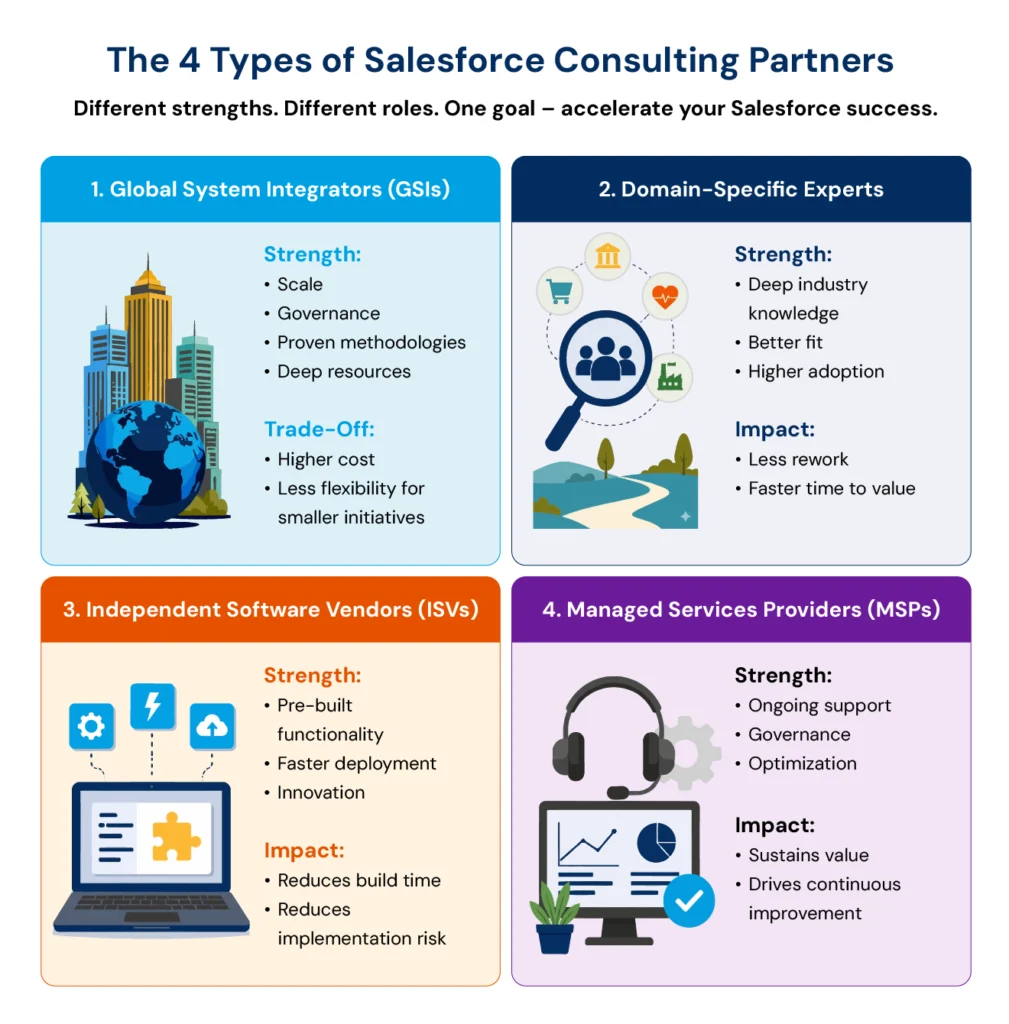
1. Global System Integrators (GSIs)
Global system integrators are large consulting firms that operate at enterprise scale, delivering large transformation programs across geographies and multiple Salesforce clouds. They bring governance, structured methodologies, and deep resources. Their strength lies in handling complexity, though the trade-off is often higher cost and reduced flexibility for smaller initiatives.
2. Domain-Specific Experts
Domain experts bring industry knowledge into implementation. They understand sector-specific processes and ensure that solutions align with real-world workflows. Their involvement typically reduces rework and improves adoption. These partners often outperform larger firms despite smaller team sizes.
3. Independent Software Vendors (ISVs)
ISVs build packaged solutions on Salesforce, extending platform functionality. These may include applications for workflow automation, analytics, or domain-specific processes. Their approach reduces development time by offering pre-built capabilities, helping organizations accelerate deployment.
4. Managed Services Providers (MSPs)
Managed services partners focus on post-implementation support and continuous improvement. They handle system maintenance, enhancements, and governance over time. Their role is essential for maintaining momentum, especially when internal teams lack bandwidth or specialized skills for ongoing Salesforce management.
How Can You Become a Salesforce Consulting Partner?
Becoming a Salesforce consulting partner requires more than technical skill. It involves building certified expertise, demonstrating delivery credibility, aligning with Salesforce’s ecosystem standards, and committing to long-term capability development and customer success at scale.
Step 1: Establish a Consulting or Services Entity
Salesforce partners must operate as formal service organizations, not individual freelancers. This means having a registered business entity with defined service offerings, client engagement models, and accountability structures. Salesforce evaluates partners as delivery organizations capable of supporting customers beyond a single implementation.
Step 2: Build Core Salesforce Expertise
Expertise is the foundation of partnership eligibility. Companies must invest in Salesforce-certified professionals across key clouds such as Sales, Service, and Platform. Certification signals baseline competence, but Salesforce also looks for hands-on experience translating platform features into real business outcomes for clients.
Step 3: Develop Real Implementation Experience
Salesforce expects partners to demonstrate successful customer implementations. This includes hands-on project delivery, solution design, configuration, and post-go-live support. Early projects often come from smaller clients, but the emphasis is on quality, repeatability, and documented success rather than project size alone.
Step 4: Join the Salesforce Partner Program
Organizations formally apply through the Salesforce Partner Program. This involves submitting business details, identifying certified resources, and agreeing to program requirements. Acceptance provides access to partner tools, training resources, and Salesforce’s broader ecosystem, but it also introduces accountability for delivery standards.
Step 5: Align with Salesforce Delivery Standards
Salesforce partners must follow prescribed delivery frameworks, security practices, and ethical guidelines. This alignment ensures consistent customer outcomes and protects the platform’s reputation. Firms that treat these standards as operational discipline, rather than compliance overhead, scale credibility faster.
Step 6: Build Industry or Capability Differentiation
Generic Salesforce skills are no longer enough. Successful partners develop specializations through industry, use cases, or platform depth. Differentiation helps Salesforce position partners effectively and allows firms to compete on expertise rather than price alone in an increasingly crowded ecosystem.
Step 7: Invest in Ongoing Training and Certification
The Salesforce platform evolves rapidly. Partners must continuously upskill their teams to stay relevant. This includes advanced certifications, new cloud expertise, and understanding platform roadmap changes. Continuous learning is not optional; it directly affects partner tier progression and client trust.
Step 8: Deliver Consistent Customer Success
Long-term partnership status depends on outcomes. Salesforce tracks customer satisfaction, project success, and retention. Firms that deliver predictable results, manage risk well, and maintain strong client relationships progress faster within the partner ecosystem and gain access to higher-value opportunities.
What Are the Key Benefits of a Salesforce Consulting Partner?
Salesforce partners do more than just set things up. They help you get the most from your investment. Explore the key advantages from expert support to increased ROI that consulting partners bring to organizations.
1. Expert Support
A Salesforce consulting partner provides expert guidance throughout your Salesforce journey. They have rich knowledge and expertise in using Salesforce products effectively. From the initial setup to ongoing support, they help you understand how to use Salesforce to reach your business goals. They assess your needs and suggest the best solutions for your organization. With their support, you can handle challenges more easily and avoid common mistakes that companies make when implementing new systems. This support ensures you make the most out of your investment and achieve better results faster.
2. Customized Solutions
Every business is different, and a Salesforce consulting partner knows this. They work with you to customize Salesforce solutions that fit your specific needs. This means they tailor features, workflows, and reports to match how your business works. By customizing the system, you’ll be able to make processes smoother and work more efficiently. This way, the software works for you, helping your team use Salesforce better, which leads to higher productivity and better results.
3. Time and Cost Savings
Working with a Salesforce consulting partner saves you time and money in the long run. These experts know how to set up Salesforce quickly, which means you may start using it sooner. They also help you avoid expensive mistakes that occur if you try to set it up yourself. By making processes easier, a consulting partner lets your team focus on important tasks instead of getting stuck on technical details. This helps you use resources effectively and reach your goals faster.
4. Ongoing Support
Another advantage of working with a Salesforce consulting partner is quick access to ongoing training and support. They provide training sessions for your team, so everyone knows how to use the system well. This training helps employees feel confident using Salesforce. They also offer support for any questions or issues that arise after setup, ensuring that your team makes the most of Salesforce over time.
5. Improved Data Management
Salesforce consulting partners help improve how your organization manages data. They assist in setting up proper data structures, so that information is organized and easy to find. With their help, your enterprise cleans up existing data, removes duplicates, and establishes good practices for entering data in the future. Better data management leads to more accurate reports and insights, helping you make informed decisions based on reliable information.
6. Enhanced Compliance
Following industry laws is important for all businesses across industries. A Salesforce Consulting Partner helps ensure that you use Salesforce in line with these laws. They stay updated on relevant regulations and add features in Salesforce that support data compliance efforts. By working with a Salesforce partner, your organization lowers the risk of problems that lead to penalties or legal issues.
7. Access to Latest Features
Salesforce regularly updates its platform with new features and improvements. A consulting partner helps you stay updated with these changes, so you can implement new features as they become available. They explain how these features can benefit your business and help you implement them effectively. By using the latest tools from Salesforce, your organization improves its operations and stays competitive.
8. Increased ROI
By working with a Salesforce implementation consultant, your enterprise may see better returns on their investment. The combination of expert help, customized solutions, and ongoing support leads to better use of the Salesforce platform. As a result, your organization reaches its goals more efficiently while boosting productivity across teams. With improved processes and data management, your company is likely to see higher revenue growth by using Salesforce effectively.
Why Salesforce Consulting Partners Treat Launch Day as Day One
How Do You Know If You Need a Salesforce Consulting Partner?
Organizations typically require a Salesforce consulting partner when internal teams lack the capacity or expertise to manage complex platform implementations. This is especially true when projects involve multiple clouds, system integrations, or business process redesign across departments such as underwriting, claims, and customer service.
More fundamentally, the need arises when Salesforce becomes strategic rather than operational. If the platform is expected to drive growth, efficiency, or compliance outcomes, internal capabilities alone are often insufficient. A consulting partner brings structured delivery, governance, and industry insight necessary to ensure successful execution at scale.
How Can You Choose the Right Salesforce Consultant?
Picking the right Salesforce consultant makes all the difference. But how do you find the right one? These practical tips will guide you to find someone who truly understands your needs.
1. Outline Your Goals and Needs
First things first: clearly define your business goals and needs when choosing the right partner. Think about what you want to achieve with Salesforce. Do you want to improve sales, make customer relationships better, or drive marketing? Write down your specific goals and any challenges you have. This will help you find a partner that specializes in what you need. Also, consider any specific industry needs that might affect how you use Salesforce. Knowing what you want helps you choose the right partner.
2. Research Potential Partners
Once you know your goals, the next step is to start looking for consulting partners. Search for companies that specialize in Salesforce consulting services. You may search on LinkedIn, seek inputs from your coworkers, or check Salesforce’s partner directory. Look for partners who have experience in your industry and a good record of successful projects. Read reviews from their past clients to understand their reputation. Make a list of partners that seem like a good fit.
3. Evaluate Certifications and Expertise
After making your list, check the certifications and expertise of each partner. Check if they have certified Salesforce consultants on their team, as this shows they know how to deliver good solutions. Look for partners with experience in specific Salesforce products that are important for your needs. Also, consider their experience in your industry; a partner who knows your industry will understand your challenges better. This evaluation helps ensure that you choose a partner with the right skills and qualifications.
| What to Look for | Why It Matters |
|---|---|
|
Administrator Certification |
Shows they know how to set up and run Salesforce properly |
|
Service Cloud Certification |
Proves they can set up customer support systems |
|
Sales Cloud Certification |
Shows they can help with sales tracking and customer deals |
|
Customization Skills |
Adjust Salesforce for special needs |
|
Data Migration Knowledge |
Move your old data to Salesforce |
|
Training Ability |
Educate your team on how to use Salesforce |
4. Review Case Studies and Success Stories
Next, look at case studies and success stories from the partners you are considering. A good partner should have plenty of examples of past projects showing their potential to deliver results. Look for details about the challenges they encountered, the solutions they designed, and the outcomes they delivered. This will give you clarity on how well they solve problems.
5. Assess Communication Skills
Good communication is important when working with a consulting partner. During discussions with potential partners, pay attention to how well they communicate with you. Are they clear in explaining their Salesforce consultancy services? Do they listen to your concerns? A partner who communicates well will understand your needs better and keep you informed during the project. Assessing their communication skills early on helps you ensure a productive working relationship.
6. Understand Their Implementation Process
It’s important to know how each consulting partner plans to implement Salesforce. Ask them about their steps for getting started with Salesforce. A good partner should have a clear plan that includes steps like discovery, design, implementation, testing, and training. They should also explain how they provide support post implementation. Understanding their process helps you gauge whether they meet your timeline and expectations effectively.
7. Discuss Ongoing Support Services
After setting up Salesforce, ongoing support is important for getting the most out of it. When looking at potential partners, ask about the support services they offer after the initial setup is complete. This might include fixing issues, training new users, or updating the system as needed. A partner that offers ongoing support helps ensure that your team continues using Salesforce effectively over time.
8. Compare Pricing and Value
Finally, compare prices among different consulting partners while thinking about the value they provide. While it may be tempting to choose the cheapest option, make sure to check Salesforce consulting services offered in such pricing plans. Look for transparency in costs, training, support, and other additional services offered. Consider the overall value each partner brings based on their skills and support rather than just focusing on price alone.
What Are the Key Capabilities of Salesforce Consulting Partners?
Salesforce consulting partners possess specific capabilities that drive project success. Explore the key abilities from business process analysis to integration with other systems that partners bring to engagements.
I. Business Process Analysis
Salesforce consulting partners begin by looking at how your business works. They check the existing processes to understand what works well and what needs fixing. This helps them find areas for improvement. By understanding these processes, they suggest the ways Salesforce makes things easier and more efficient. They also use Salesforce’s reporting tools to show how customers interact with your business and how well things are going. This data is important for making smart decisions that improve business.
II. Implementation
They help your business set up the Salesforce system from the beginning. They customize the system to fit the company’s needs, move existing data into Salesforce, and make sure everything works well. They guide your company through the setup process, ensuring all features match their goals. This is important for companies that are new to Salesforce or those upgrading their systems. Experts handling the setup help avoid common mistakes and ensure a smooth start.
III. Customization and Development
Every business has different needs, and Salesforce summit partners tailor the platform to meet these needs. This includes creating custom apps, workflows, and connections that improve how Salesforce works. By personalizing the system, businesses make their processes better and serve customers more effectively. Customization is important for companies that need special features that are not found in the standard Salesforce package. For instance, a consulting partner helps in customizing the sales performance dashboard that displays key metrics like total sales, sales by region, lead source, and expected revenue using visual charts for easy tracking.
IV. Data Migration
Did you know? 83% of data migration projects either fail or exceed their budgets and schedules. Moving data from old or legacy systems to Salesforce is tricky. Consulting partners make sure this process is done safely and efficiently, reducing the chances of losing or damaging data. They plan and carry out the migration, ensuring all important data is transferred correctly and work well with Salesforce. This service is crucial for companies that deal with large amounts of data or those switching from another system.
V. User Training and Change Management
To help employees use Salesforce well, consulting partners provide training sessions for different user roles in the company. They also help manage the changes that come with new technology. Furthermore, offering guidance during the transition helps users gain confidence and feel more comfortable using the new system. This service leads to better use of Salesforce and higher satisfaction among users.
VI. Ongoing Support
After setting up Salesforce, companies need regular support to fix any issues and keep the system performing well. Consulting partners provide continuous maintenance services, including bug fixing, updating software, and improving performance over time. This helps companies make the most of their Salesforce investment as their needs evolve.
VII. Integration with Other Systems
Many businesses use different software tools along with Salesforce. Consulting Partners help connect these systems, so they work together smoothly. This connection allows for better sharing of information between the tools, making everything run more efficiently. By connecting different software, businesses simplify their work and boost productivity.
What Are the Different Tiers of a Salesforce Partner Program?
Salesforce simplified its partner program by replacing four legacy tiers with two: Select and Summit. Select reflects proven delivery capability, while Summit represents top-tier partners aligned to strategic growth and measurable outcomes.
| Criteria | Select Partner | Summit Partner |
|---|---|---|
|
Positioning |
Foundational, proven delivery tier |
Top‑tier, strategic growth tier |
|
AI‑Centricity |
Leverages AI capabilities in delivery |
Leads with agentic AI, co‑designing AI‑driven solutions |
|
Performance |
Meets core competency and delivery standards |
Exceeds benchmarks in certifications, projects, and customer success |
|
Partner Benefits |
Standard technical and marketing support |
Expanded benefits, privileged access management, advanced GTM, and success‑management resources |
|
Best Fit For |
Small to mid-sized implementations |
Large or complex programs needing strategic AI and platform leadership |
“Partner programs are critical scaffolds that dictate how a vendor engages with its ecosystem. In this latest program change, Salesforce is rebuilding the bridge between human expertise and AI autonomy. This move aims to rewire the ecosystem’s nervous system for the agentic era.”
– Alex Smith, VP & Practice Lead, Ecosystems, Channels, and Marketplaces at the Futurum Group.
Summing Up
Partnering with Salesforce consultants greatly enhances your company’s ability to utilize Salesforce effectively. These partners bring valuable expertise that helps in implementing, customizing, and optimizing Salesforce to meet your specific needs. Overall, a Salesforce consulting partner helps you achieve your business goals more efficiently. With their support, you can improve decision-making, enhance customer satisfaction, and increase your return on investment. As you consider integrating the Salesforce system into your operations, remember that choosing the right Salesforce implementation consultant makes all the difference to your success.