Integration Services
 Business Consulting & Advisory
 AI Solutions
 AppExchange Development
 Tailored Salesforce Engineering
 Managed Services
 Implementation

Key Takeaways:
- Salesforce CPQ end-of-sale does not mean immediate migration is required.
- Existing CPQ systems keep working under current support agreements.
- Managed services keep legacy CPQ stable as support resources shrink.
- Cleanup work like catalog audits reduces future migration costs significantly.
- Agentforce Revenue Management requires full re-implementation, not a simple upgrade.
- Choose CPQ consultants who honestly recommend staying put when appropriate.
What should organizations still running Salesforce CPQ do now?
Salesforce stopped selling the product to new customers in March 2025 1. Many companies have treated this news like a death sentence for their CPQ setup. But that panic does not match reality.
Salesforce has not announced an end-of-life date yet. Existing CPQ environments still work. Support continues.
What has changed is the product roadmap. Salesforce has stopped building new features for CPQ. The gap between CPQ and its successor widens every quarter. But it does not mean every organization should migrate immediately.

That is why Salesforce CPQ consulting in 2026 is all about a smooth transition that happens in three phases: operate your current system with reliable managed services, prepare through cleanup, and transition only when your timeline requires it.
Achieva, as a Salesforce Summit partner, supports organizations through all three phases without imposing artificial urgency.
Table of Content
- What End-of-Sale Actually Means for Salesforce CPQ
- What CPQ for Salesforce Means Now
- Phase 1: Operating Current CPQ with Salesforce CPQ Managed Services
- Phase 2: Preparing for the Transition with Strategic Cleanup
- Phase 3: Planning the Transition to Agentforce Revenue Management or Alternatives
- How to Choose a Salesforce CPQ Consulting Partner in 2026
- How Achieva Supports CPQ Estates Through Transition
- Conclusion
What End-of-Sale Actually Means for Salesforce CPQ
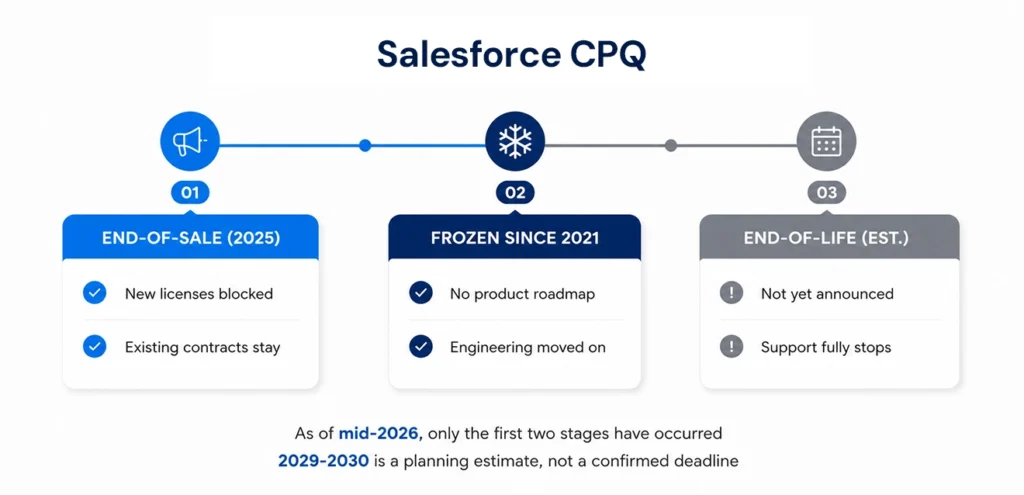
Let us break down what happened and what it means for your organization. There are three distinct concepts to understand: end-of-sale, end of new feature development, and end-of-life.
1. End-of-Sale: What Changed for Existing Customers
Salesforce confirmed the end-of-sale announcement in March 2025. No new organizations can now purchase Salesforce CPQ licenses going forward. Companies evaluating CPQ for the first time cannot implement this legacy product.
But here is what did not change. Existing CPQ customers retain full access to their environments. They can renew licenses, purchase additional user seats, and operate under their current agreements. Support continues under existing service-level commitments.
There is one nuance worth noting. Bug-fix response times have slowed. Partner resources are thinning as specialists retrain on Agentforce Revenue Management. The product works, but the support infrastructure around it is gradually contracting.
2. End of New Feature Development: A Frozen Product Roadmap
Feature development for Salesforce CPQ has ceased. The product has received no meaningful updates in more than four years. Performance constraints identified in 2021 2 remain unresolved today.
Engineering resources have shifted to Agentforce Revenue Management.
The product now operates in maintenance mode. Security patches and limited bug fixes continue. But there will be no feature improvements. No product roadmap investment. Organizations relying on CPQ are running a system frozen in its current state.
3. End-of-Life: The Unconfirmed 2029-2030 Timeline
Salesforce has not announced an official end-of-life date. Partners and analysts commonly project a sunset around 2029 to 2030 3. They base this on typical enterprise software lifecycle patterns. They estimate a four-to-five-year window between end-of-sale and end-of-life. But these remain planning assumptions, and not Salesforce commitments.
What happens after the end of life? Support discontinues. No security patches. No bug fixes. No technical assistance. Organizations should treat 2029 to 2030 as a reference timeline for migration planning, though it is not a confirmed deadline.
4. What This Means for Your CPQ Investment
For now, the existing CPQ installation can keep creating quotes and processing revenue without disruption. The product will not stop functioning because of the announcement.
But the growth path has changed. Clients no longer receive updates. The gap between CPQ capabilities and modern alternatives widens each quarter.
There is a real decision window, but customers hold the power to set the timeline. They can set their own migration schedule, based on their system performance, business needs, and budget. Not on someone else’s countdown clock.
Here's Your Comprehensive Guide to Salesforce CPQ Implementation
What CPQ for Salesforce Means Now
The landscape has changed for anyone looking at Salesforce CPQ. The legacy product is simply unavailable for new buyers. This section explains your actual options and what they mean for your business.
I. Why New Customers Cannot Buy Salesforce CPQ
Organizations evaluating CPQ for Salesforce cannot purchase the legacy product. Salesforce CPQ licenses are unavailable to any company not already holding an active contract. The end-of-sale policy blocks new implementations and redirects prospective buyers toward Agentforce Revenue Management or third-party solutions.
Contract transfers or reseller channels offer no supported path to acquire CPQ secondhand. Salesforce does not enable license transfers to new organizations outside existing customer relationships. In such a scenario, the decision for new buyers reduces two categories: Salesforce’s native successor or AgentExchange alternatives.
II. Agentforce Revenue Management: The Official Successor
Agentforce Revenue Management serves as Salesforce’s replacement platform, built natively on the Einstein 1 core rather than as a managed package. Its architecture delivers server-side pricing engines, OmniStudio quoting interfaces, and attribute-based product catalog management that replaces legacy product logic.
The product covers the full revenue lifecycle. CPQ focused on quoting, but Agentforce Revenue Management extends into contract management, order capture, subscription amendments, consumption tracking, and invoicing under a single data model.
Two pricing editions exist, according to Salesforce’s official pricing page:
- Growth Edition at $150 per user per month 4 (billed annually). This includes quoting, configurator, order capture, and subscriptions.
- Advanced Edition at $200 per user per month. This adds everything in Growth plus contracts, consumption billing, invoicing, and AI and analytics.
Moving from legacy CPQ to this new system requires full re-implementation. Organizations must redesign their product catalog, recreate pricing rules, and map approval workflows to the new data model. They also need to budget realistic timelines and prepare major data migration work.
III. Third-Party CPQ Alternatives Worth Evaluating
Third-party CPQ platforms remain available on the AgentExchange. Popular options include:
- Conga: Suited for businesses with detailed contract lifecycles
- DealHub: Good for teams that need step-by-step guided selling
- Experlogix: Designed for complex manufacturing and product assembly rules
- SAASTEPS: Built for speed, claiming setup times of just two to four weeks by using standard Salesforce fields.
Companies should look at their pricing models and billing needs when evaluating the above-mentioned models. Some of these solutions run as external systems that sync back to Salesforce. Others, like SAASTEPS, build on top of standard Salesforce objects and keep data in one place. The final choice depends on whether their teams only need quoting functionality or complete quote-to-cash coverage.
Phase 1: Operating Current CPQ with Salesforce CPQ Managed Services
This phase is about keeping the current system running well. Even if an organization plans to migrate eventually, their CPQ estate will likely operate for years. The goal here is stability, and not an indefinite extension.
1. Why Managed Services Matter More After EOS
The current CPQ installations will keep processing quotes and driving revenue cycles long after the end-of-sale date. Because the estates will likely run for several years before migration, someone must maintain them.
The talent pool for legacy CPQ has begun to shrink. Certified CPQ specialists and experienced administrators are now retraining the new platform. Finding consultants who understand legacy CPQ architecture well is becoming harder by the day. At the same time, Salesforce has shifted its support focus to its newer products. Because of this, bug-fix response times for older CPQ setups are slowing down.
This talent shift leaves internal teams holding complex systems they did not build, driving the need for reliable Salesforce CPQ managed services.
2. What Salesforce CPQ Managed Services Cover
Managed services for CPQ provide ongoing operational capacity in these core areas.
- Admin and configuration support handles routine updates, field changes, and user requests without consuming internal bandwidth.
- Price-rule maintenance cleans up redundant pricing logic and documents the calculations hidden in the system.
- Approval workflow care manages approval chains, parallel approver configurations, and rule updates as business requirements change.
- Quote Calculator Plugin performance optimization addresses calculation bottlenecks. Large quotes with more than 200-line items can take a lot of time to load. A thorough QCP code review can make these calculations run much faster.
- Release-effect assessments check each Salesforce seasonal update against the CPQ configuration and identify breaking changes before they reach production.
- Technical debt containment prevents temporary workarounds, such as unplanned customization, from building up.
- Estate documentation captures current-state architecture and prepares the organization for transition by creating the knowledge base any migration partner requires.
3. Cost vs Risk: The Stay-and-Stabilize Calculation
When deciding on Salesforce CPQ consulting services, organizations must weigh the monthly service fees against the hidden costs of maintaining systems alone. The latter includes:
- Salary of a full-time CPQ expert
- Productivity lost when the IT team constantly resolves issues
- Technical debt accumulation that makes future migration expensive
In the end, managed services are not about keeping the legacy CPQ forever. This phase has an exit point. Their value lies in keeping the old system stable and secure while the company sets its own migration timeline rather than acting on an emergency created by deferred maintenance.
How to Evaluate a Salesforce Managed Service Partner
Phase 2: Preparing for the Transition with Strategic Cleanup
This phase is about getting the CPQ estate in order before migration. Think of it as decluttering your house before moving. The work done here pays off regardless of where you go next.
I. Product Catalog Audit (Retire Ghost Products)
Product catalogs accumulate inactive SKUs, discontinued offerings, and configuration options no longer sold but never retired. These “ghost products” clutter selection interfaces and become baggage in any migration.
Salesforce CPQ offers two ways to retire from such products without losing historical data.
- The first method creates a custom checkbox to flag discontinued products. A hidden search filter then removes these items from the Product Selection page on new quotes. They only remain available for renewals and amendments.
- The second method deactivates products but keeps their price book entries active. This removes them from new sales while still allowing them to appear as bundled options in the Product Configurator.
II. Pricing-Rule Rationalization
Companies often build multiple pricing rules that perform the same calculations. Many times, these rules conflict with one another and create complexity during migrations.
Rationalization starts by identifying rules with similar objectives and then consolidating them through lookup-query methods. That way, separate rules are replaced with a single rule that queries a custom object containing all the pricing variations. Administrators can see the pricing logic in a structured format. No need to dig through dozens of rules.
III. Quote and Contract Data Hygiene
Quote and contract records get carried forward during migration. When the underlying is not cleaned before migration, it can create serious issues on the destination platform. To fix this, organizations need to:
- Set up deduplication rules to merge duplicate SKUs
- Rebuild outdated bundles that do not reflect actual configuration logic
- Update missing product attributes before catalog migration begins
IV. Process Documentation
Documentation is a task many organizations neglect in CPQ estate management. Many times, workflow descriptions, system configurations, pricing rule logic, and customizations exist only in institutional memory until the employees hold that memory to leave.
Regular updates preserve this knowledge and help new team members onboard easily. Documentation created during cleanup becomes the knowledge base any migration partner needs from day one.
Phase 3: Planning the Transition to Agentforce Revenue Management or Alternatives

Moving from Salesforce CPQ to Agentforce Revenue Management is a re-implementation, not an upgrade. That distinction matters a lot for budgeting, timelines, and organizational readiness.
1. What Agentforce Revenue Management Implementation Involves
Legacy CPQ runs on managed package custom objects. The new platform uses standard platform objects. Users cannot simply export their current setup and import it into the new system. Product rules, bundles, and pricing logic must be rebuilt.
The new architecture introduces several fundamental changes. Product Catalog Management uses attribute-based definitions instead of legacy product logic. Server-side pricing engines replace JavaScript Quote Calculator Plugins. OmniStudio replaces old quoting screens.
Salesforce CPQ implementation services providers usually require six to eighteen months to complete the switch because of these deep structural changes.
2. Third-Party Alternatives
Third-party CPQ platforms remain available and, for certain organizations, represent a better fit. Established vendors include Conga CPQ, Oracle CPQ, DealHub CPQ, and SAP CPQ, among others.
Organizations should focus on how well these tools handle their specific pricing models and how cleanly they connect to their CRM when evaluating and comparing them. The AgentExchange marketplace lists pre-vetted options that fit various complexity levels and setup preferences. For instance, if a business relies heavily on complex contract lifecycle management, Conga might be worth a closer look.
3. The Decision: Move Sooner or Stay Short-Term
Migrating immediately is not always the right move. The decision depends on what the current CPQ environment can and cannot do for a business.
Migration becomes a priority when:
- CPQ performance ceilings constrain quoting speed.
- Usage-based or hybrid subscription pricing models exceed what the platform can handle.
- AI and Agentforce capabilities require a native core platform architecture.
- Renewal economics and licensing costs shift unfavorably.
Staying on CPQ short-term makes sense when:
- Quoting operates stably and serves current business requirements.
- Significant recent CPQ investment still amortizes.
- Other transformation initiatives are consuming organizational bandwidth.
- The team lacks the capacity to execute a re-implementation properly.
How to Choose a Salesforce CPQ Consulting Partner in 2026
Not all Salesforce CPQ consultants are equipped for this market. The end-of-sale changes what an organization needs from a partner. This section explains exactly what to look for and what questions to ask before hiring anyone.
I. What to Look for in a Salesforce CPQ Consultant
The vetting criteria for this market are specific. General Salesforce delivery experience does not suffice.
Dual-platform capability is the baseline filter. The consultant must have extensive experience with both legacy CPQ architecture and the Agentforce Revenue Management platform.
Migration references on the new data model matter more than generic platform credentials. A consultant who has delivered projects based on older migration patterns may not understand the current re-implementation requirements.
Willingness to recommend staying put is the most revealing test. Ask explicitly: when would you advise migrating right now? Consultants who cannot answer that question are selling urgency instead of doing an honest assessment.
Managed-services depth determines whether they Salesforce CPQ consulting partner can handle both high-level project work and long-term support.
Cleanup methodology signals whether they treat the prepared phase seriously. They should view data hygiene as essential preparation that lowers migration costs. If they treat it simply as a billable activity, the costs will rise later.
II. Questions to Ask Before Hiring
Put these questions to any prospective Salesforce CPQ consulting partner before signing a contract:
- Have they delivered both CPQ and Agentforce Revenue Management projects within the last 12 to 18 months?
- Can you create a realistic ‘stay and stabilize’ plan for the current system without pushing a full migration proposal?
- How do they approach technical debt, and what does long-term maintainability look like in their delivery model?
- Who specifically works on the project? Not the firm’s credentials, but the actual individuals.
- What does their post-launch support look like once the project closes?
How Achieva Supports CPQ Estates Through Transition
Achieva operates as a Salesforce Summit Partner and brings over 20 years of experience delivering robust ecosystem solutions. The designation verifies our proven track record of technical execution and client success.
We support organizations through all three phases of the CPQ transition without imposing artificial timelines.
- For the operating phase, our managed services keep the existing CPQ estate running smoothly. We handle admin capacity, pricing-rule maintenance, and release-impact assessments while the system continues to process revenue without interruptions.
- For the preparation phase, our strategic cleanup engagements focus on product catalog audits, pricing-rule rationalization, and data hygiene. We treat this as structured health-check work that reduces migration costs.
- For the transition phase, we execute migrations to Agentforce Revenue Management only when the business timeline demands a shift. Our experience covers the full re-implementation journey from legacy CPQ to the new platform.
Our service model removes vendor-driven timeline pressure. We structure our managed services, cleanup, and re-implementation with the same fair billing approach.
Our Salesforce CPQ consulting engagement begins with an assessment of your current system rather than a pre-packaged recommendation. We help you move only when your business is prepared for the shift.
Conclusion
The end-of-sale announcement is an opportunity to strategize, not a reason to panic. The current CPQ system still works well, and you control the timeline. Focus on keeping it stable with managed services and cleaning up your product data. This builds a strong foundation for any future move, whether to Agentforce Revenue Management or an alternative. Achieva is here to support you at every stage, with honest guidance and no urgency bias.
References: