Integration Services
 Business Consulting & Advisory
 AI Solutions
 AppExchange Development
 Tailored Salesforce Engineering
 Managed Services
 Implementation

Can self-published “Top 10 Salesforce implementation consultants” lists help CIOs and CTOs select the right CRM implementation partner? They can’t. Search today and see that the top results are dominant self-published content, where consultancies place themselves in the top three, and optimize search. The lists provide no decision framework. Yet they saturate search results because nobody publishes the framework1 that would actually serve buyers.
The core issue is that selection is treated as a ranking problem when it’s a fit-matching question. This fragmentation makes universal “best” rankings meaningless. For instance, a Tier-1 enterprise running a multi-cloud Salesforce implementation with Agentforce deployment requires different capabilities than a $50M company’s first deployment. Even if the ranking format worked, the criteria most lists use (Summit tier, certification count, cloud coverage) are 2022 metrics missing that 2026 Salesforce implementation partners need Agentforce depth, Data 360 integration, and continuous engineering capability that the self-published lists haven’t absorbed.

Table of Content
- What Has Changed in Salesforce Implementations Between 2022 and 2026?
- What Is the Five-Lens Evaluation Framework for Choosing a Salesforce Implementation Partner?
- What Is the Practical Scoring Approach for Applying the Framework?
- What Goes Wrong After Go-Live and Why Is It a Partner Selection Problem?
- Who Is the Best Salesforce Implementation Partner for the Specific Engagement?
- How Does Achieva Approach Salesforce Implementation Partner Engagements?
What Has Changed in Salesforce Implementations Between 2022 and 2026?
What changed between 2022 and 2026 is not Salesforce’s surface capability; it’s where architectural risk lives. The center of gravity has shifted away from configuration speed and toward data foundations, AI behavior, and post‑go‑live evolution.
Shift 1: Agentforce Has Moved the Architectural Center of Gravity
In 2022, Salesforce implementation services2 centered on object model design, Flow automation, Process Builder configuration, and Lightning component development. These remain necessary. But in 2026, Agentforce changed that equation. The architectural decisions that determine implementation success are agent design, prompt engineering for enterprise contexts, deterministic guardrails on autonomous actions, and human-in-the-loop checkpoint design.

A partner whose senior architects haven’t built production agent architectures is solving the 2022 problem with 2022 tools. The implementation will be technically competent on yesterday’s platform and structurally unprepared for the capabilities that will define the next five years.
Shift 2: Data Cloud Has Become Foundational, Not Optional
Previously, data architecture could be deferred since implementations often launched with fragmented data models and integration workarounds, with cleanup scheduled “after go‑live.” That approach was survivable in a non‑AI first platform.

In 2026, it’s not since Data Cloud has become foundational, and this is demonstrated by the fact that nearly half of the Fortune 1003 are active customers of Data 360. Agentforce and Einstein consume whatever the Data 360 unifies. Identity resolution, data freshness, and ingestion governance now directly determine AI output quality. A Salesforce partner without serious Data 360 architecture depth delivers an Agentforce-ready implementation that looks functional but degrades quickly under real AI usage. Data 360 competency is not an add-on track; it is the prerequisite that determines whether AI capabilities work in production.
Shift 3: Build‑to‑Operate Has Overtaken Build‑to‑Handoff
AI accelerators, low‑code tooling, and industry templates have compressed implementation timelines. What has not been compressed is the cost of operating, governing, and evolving a Salesforce org across its five-to-ten-year operational lifespan.

This changes the economics of a Salesforce implementation. The partner who is fastest to launch is rarely the partner who minimizes long‑run costs and risks. Therefore, partners must be evaluated on their ability to operate and evolve the system. Salesforce implementation services that end at go-live transfer the evolution problem to the client, often without the institutional knowledge to solve it.
Shift 4: Evaluation Criteria Have Lagged Platform Evolution
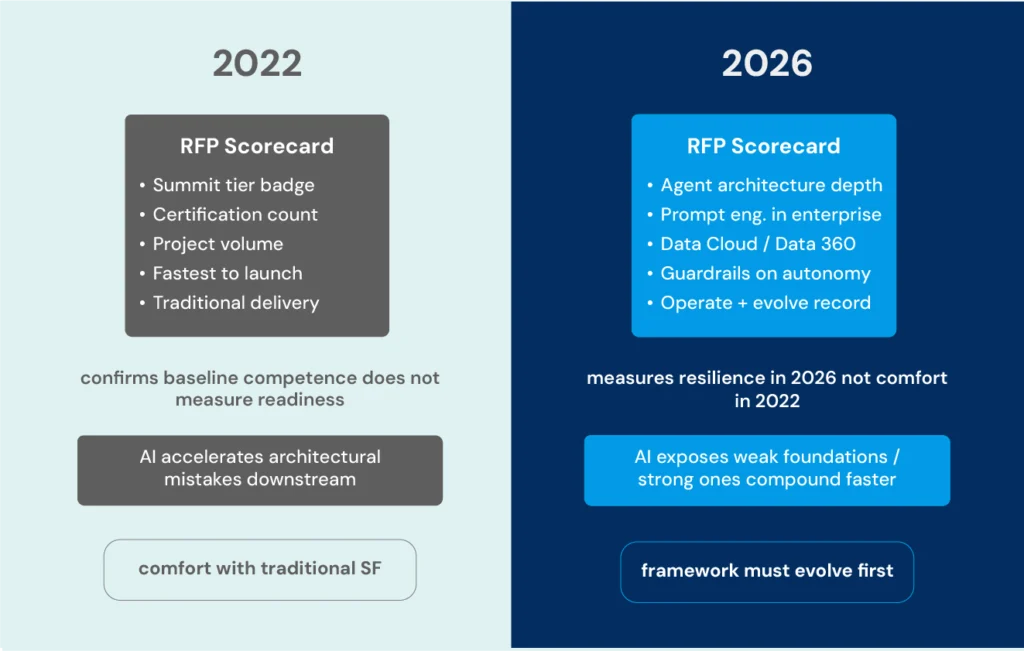
Despite these shifts, most RFPs still score partners on Summit tier badges, certification counts, and project volume. These indicators confirm baseline competence, but they do not measure readiness for Agentforce, Data Cloud, or continuous evolution.
Is your current Salesforce partner ready for Agentforce? Get a free readiness assessment.
AI-driven implementation accelerators compress built time, but they also accelerate architectural mistakes downstream. AI does not fix weak foundations; it exposes them sooner. Salesforce implementation partners selected in 2022 criteria show comfort with traditional Salesforce implementation, not resilience in 2026. The evaluation framework must evolve before the RFP does.
“Too many companies budget for implementation, but not for evolution.”
– Ravi Jain, SVP, Salesforce & Analytics at Algoworks.
What Is the Five-Lens Evaluation Framework for Choosing a Salesforce Implementation Partner?
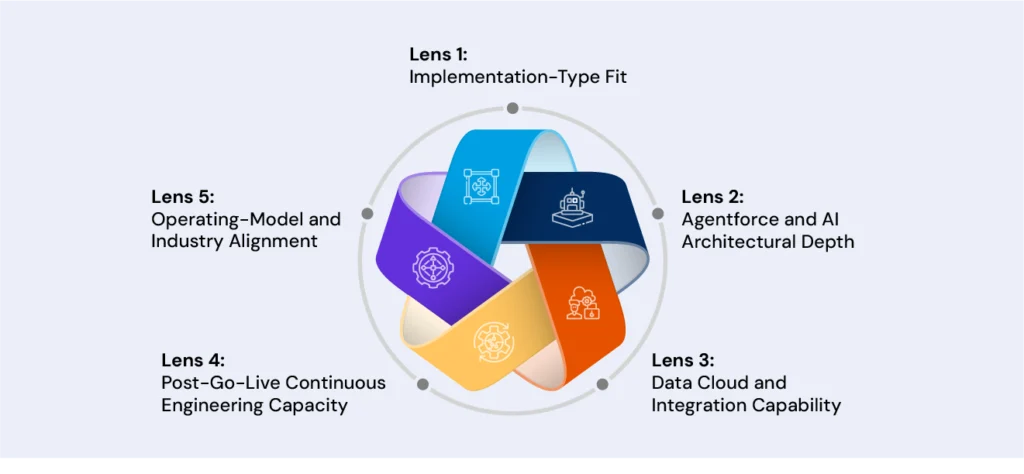
Choosing a Salesforce implementation partner in 2026 requires a different framework than 2022 demanded. The platform has shifted; the partner evaluation process has not. Explore the five lenses that separate strategic implementation partners from project vendors who excel at impressive sales pitches.
Lens 1: Implementation‑Type Fit
What it asks: Has the Salesforce partner delivered the specific implementation archetype this engagement requires?
Salesforce engagements fall into 4 distinct archetypes:
- First‑time deployments
- Multi‑cloud enterprise rollouts
- Replatforming or post‑M&A consolidation
- Industry‑specific cloud implementations
Each requires different architectural judgment, stakeholder management, and delivery methodology. Excellence in one rarely translates to another.
Failure mode it prevents: Choosing a Salesforce implementation partner whose reference projects sound impressive but reflect a different archetype. When references don’t match engagement shape, risk shifts silently to the buyer.
Lens 2: Agentforce and AI Architectural Depth
What it asks: Is the partner capable of production‑grade AI architecture, or are they rebranding workflows as Agentforce?
This lens differentiates between partners selling AI as a marketing label and those who have built production-grade agent systems with deterministic guardrails, observability, and human-in-the-loop controls.
Partners cluster into three tiers:
- Marketing-tier partners claim AI capability without production builds
- Workflow-tier partners deploy Einstein features and copilot integrations
- Architecture-tier partners with senior architects who’ve designed agent systems with proper governance infrastructure
Many Salesforce partners in 2026 self-classify as architecture-tier in proposal materials; however, most deliver marketing-tier in production.
The diagnostic: ask specifically which production Agentforce deployments their senior architects led, what guardrails they designed, and how they handled hallucination risk in customer-facing contexts.
Failure mode it prevents: This lens prevents selecting a Salesforce implementation consultant whose AI story sounds future-ready but collapses under real operational load.
Lens 3: Data Cloud and Integration Capability
What it asks: Does the partner treat Data Cloud (Data 360) as foundational architecture or as a product slide?
Data 360 architecture now determines whether AI capabilities produce reliable output or confidently wrong output at scale. Partners with real depth show tight integration between Data Cloud, MuleSoft, enterprise systems, and governance models. Those having a shallow Data Cloud experience deliver impressive AI demos that degrade within months of go‑live when the data foundation fails under production load.
Failure mode it prevents: Choosing a partner whose AI capabilities look strong in controlled demonstrations but collapse in production because the Data 360 foundation was never properly designed.
Lens 4: Post‑Go‑Live Continuous Engineering Capacity
What it asks: Does the partner stay engaged once the system is live?
Go-live is no longer the end of the engagement; it is the beginning of value realization. This lens examines whether the partner’s operating model supports continuous evolution or whether the team disappears once milestones are signed off.
Salesforce partners primarily operate in three models: project‑only partners, limited managed services partners, or continuous engineering partners with dedicated capacity that evolves the Salesforce org alongside the business through Agentforce releases, Data Cloud updates, and product expansion.
Failure mode it prevents: Choosing a partner who delivers a technically sound go-live and then disappears, leaving internal teams to absorb org configuration drift, agent and AI capability decay, broken integrations, and user adoption loss because they were never staffed to handle. Salesforce announces three major releases annually, which means every implementation begins depreciating the day it launches without continuous engineering. Project partners optimize for the day they leave, whereas continuous engineering partners optimize for beyond 24 months.
Lens 5: Operating‑Model and Industry Alignment
What it asks: Does the partner understand the buyer’s operating model and how the industry actually operates?
Salesforce industry clouds now encode regulatory logic, data models, and workflows. Generic playbooks may “work,” but often produce sub‑optimal outcomes in regulated or complex environments.
Failure mode it prevents: This lens prevents suboptimal deployments that technically “work” while quietly constraining scalability, compliance, and business agility in financial services, healthcare, insurance, or nonprofit environments.
Want us to apply this Five-Lens Framework to evaluate your current Salesforce setup?
What Is the Practical Scoring Approach for Applying the Framework?
The five-lens framework becomes useful when it generates decisions, not just analysis. Translating it into an operational scoring approach gives evaluation teams an enterprise-level decision baseline for partner comparison, forces explicit trade-off discussions, and produces a defensible recommendation for board and CFO review.
Component 1: A Five‑Lens Scoring Rubric
A structured scoring approach helps compare partners based on clear criteria instead of sales claims. It turns evaluation into a measurable process.
- Convert each lens into clear questions and score responses
- Use scoring to compare partners on a common scale
- Ask for real examples, architects, and delivery proof
- Uneven scores often indicate a short-term project vendor
Component 2: Reference Customer Validation Protocol
Reference checks should confirm claims, not repeat them. The goal is to understand how partners perform in real situations, especially after go-live when most challenges appear.
- Ask for references from the same type of implementation
- Focus on what happened beyond 6, 12, and 24 months
- Ask what went wrong and how the partner handled it
- Lack of failure stories often signals limited real-world experience
Component 3: Red Flags That Override Scoring
Some warning signs clearly indicate a poor partner fit, no matter how strong their score looks. These issues often lead to failure and should be addressed early.
- No confirmed senior architects assigned from day one
- AI claims without real production examples
- Unable to provide live customer references
- Hesitation to commit to post-go-live support terms
The Framework as a Starting Point
The 75-point scoring rubric produces a structured comparison, not a decision. It removes obvious mismatches and surfaces risk early. The final choice still requires CIO‑level assessment of trust, culture alignment, and partnership intent.
What Goes Wrong After Go-Live and Why Is It a Partner Selection Problem?
Most Salesforce initiatives don’t fail at launch; instead, they fail quietly 6-18 months later. By then, the CIO is focused on the next priority, the implementation squad has dispersed, and the partner has rotated staff. The Salesforce org begins drifting silently and incrementally, without anyone owning the trajectory. That is why choosing a Salesforce implementation partner4 is really a choice about who stays responsible after the applause ends, not just who reaches production on time.
Pattern 1: Org Configuration Drift
The first failure pattern is a configuration drift. What launched as a governed architecture becomes a patchwork of ad hoc changes. The live Salesforce org no longer reflects its original architecture or decision rationale.
This drift is not an admin failure. It stems from selecting a partner who built the implementation optimized for project closure, not for continuous configuration of ownership and evolution. Only continuous engineering partners with formal configuration governance keep the org aligned as changes accumulate.

Pattern 2: Agentforce and AI Capability Decay
Agentforce agents often launch cleanly and impress early users. Months later, underlying business processes evolve, policies shift, and data patterns change, but the agents remain static. Agent output quality declines quietly, without obvious errors, until trust erodes.
AI capability decay is particularly insidious because it is invisible on standard Salesforce dashboards. Preventing this decay requires a Salesforce implementation partner with AI lifecycle management, not just AI deployment capability. Partners must revisit prompts, logic, and decision paths as processes evolve. CRM partners who built the implementation optimized for delivery milestones have little incentive to continuously evolve AI capabilities beyond go-live.
“Trust isn’t just about safety; it’s about permissions. A public-facing agent needs different capabilities before and after a user authenticates. It must dynamically unlock skills without ever exposing data to the wrong person.”
– Adam Evans, EVP & GM of the Salesforce AI Platform
Pattern 3: Integration Erosion
Salesforce integrations that worked at go-live quietly break with schema changes, API version updates, field additions, and data model modifications. Sync rules that worked at go-live break silently six months later. This invisible erosion is one of the key reasons why more than 80% of AI projects fail to deliver value5.
The problem is rarely spotted early. It appears later in executive reporting, forecasting errors, or reconciliation gaps. Partners who both design and monitor integrations can detect and correct erosion; others disappear once the interface “works.”
Pattern 4: User Adoption Plateau and Reverse Migration
Adoption often peaks at launch. Months later, users begin rebuilding shadow spreadsheets because Salesforce no longer fits how work gets done. Training refreshes do little because the issue is structural, not behavioral.
Sustained adoption depends on evolving workflows alongside the business. This requires partners with continuous engineering capacity, not just enablement teams. Salesforce CRM implementation partners that stay engaged prevent reverse migration by adapting the org, not re‑teaching it.

Why All Four Are Partner Selection Problems
Each failure pattern looks different, but they share a root cause. A partner who built the implementation optimized for project closure produces drift, decay, erosion, and adoption loss. Those who built the implementation for post‑go‑live continuity prevent all four failures. The question is not whether continuous engineering capacity is needed. The question is whether it has been contracted before go-live or is being scrambled for once the first failure pattern surfaces.
Don't let your Salesforce org drift after go-live. Achieva's continuous engineering model keeps your implementation evolving.
Who Is the Best Salesforce Implementation Partner for the Specific Engagement?
The original query, “Who is the best Salesforce implementation partner?” assumes all engagements need the same thing. They don’t. A Sales Cloud rollout with light customization requires a different architectural depth than a multi-cloud, Data 360 anchored AI deployment. The framework separates partners by what they’re architecturally built to sustain, not market positioning.
Partner mismatch is invisible at go-live and expensive by year two. Agentforce adoption, agent governance, and continuous platform releases expose whether partner’s operating model supports evolution or requires rip-and-replace cycles. The best partner isn’t universally the best. It’s the one whose capability profile matches the engagement’s five-year technical trajectory.
How Does Achieva Approach Salesforce Implementation Partner Engagements?
Most Salesforce partners scope engagements to go-live and handoff. Achieva approaches Salesforce implementation services as a continuous engineering partnership, scoped at implementation but designed for post‑go‑live evolution. With Salesforce Summit Partner credentials, certified depth across Sales Cloud6, Service Cloud, Marketing Cloud, Data 360, Agentforce, and Achieva’s robust engineering capacity, the operating model fits engagements requiring post-deployment evolution.
In markets where every Salesforce implementation partner can deploy orgs, what distinguishes Achieva is that engagements continue beyond go-live through the evolution phase, determining whether implementations deliver value beyond 24 months or stall after deployment. Achieva’s post-launch support extends into secure integrations, managed services, feature enhancements, and Agentforce-enabled decision support, helping clients maintain momentum after deployment. That continuity matters because it turns Salesforce from a project milestone into a living system that can keep improving how teams work, sell, serve, and scale. This makes Achieva a fit for organizations that want their Salesforce environment to mature after launch, not plateau at handoff.