 Integration Services
 Business Consulting & Advisory
 AI Solutions
 AppExchange Development
 Tailored Salesforce Engineering
 Managed Services
 Implementation

The world has been experiencing unprecedented technological advances over the last few years. It all began in 2020, the year the pandemic redefined the way we work and collaborate, making remote work the new normal. At the same time, COVID-19 disrupted business operations, particularly for organizations reliant on legacy/on-prem systems.
Five years later, we have seen increased adoption of technologies such as artificial intelligence (AI), cloud computing, and IoT, as well as CRM platforms such as Salesforce and HubSpot, across enterprises. Similarly, professionals are increasingly leveraging Generative AI tools such as ChatGPT and Google Gemini to accelerate productivity. As a result, people now expect AI-powered experiences by default. Gartner predicts 40% of enterprise apps will feature AI agents by 2026. That said, this growing reliance on AI has also intensified regulatory pressures around data privacy and compliance. Enterprises that can skillfully balance innovation with responsible AI practices will lead.

While large enterprises with dedicated digital transformation offices can navigate this shift with relative ease, mid-sized organizations may face some challenges. They typically operate with lean teams, unclear CRM roadmaps, and fragmented Salesforce implementations. For instance, many such organizations subscribe to multiple Salesforce Clouds but often overlook the complexity they introduce. According to a Salesforce report, only 37% strongly agree that their organizations fully leverage their CRM. It highlights huge untapped potential. This is where Strategic Salesforce Advisory Services takes center stage.
These services act as a strategic bridge, helping mid-sized organizations fully understand, optimize, and govern their Salesforce investments more effectively. Let’s learn how it helps identify inefficiencies, solve complex challenges, and present tangible business outcomes.
The Mid-Sized Company Dilemma
Some of the challenges mid-sized organizations face include:
1. Implementation Without a Long-Term Vision or Goal:
Many companies begin their Salesforce journey with the right intent, but without a long-term roadmap or governance structure. As a result, their Salesforce investments often operate in silos that do not support broader business growth. Only a few organizations view their Salesforce investments through a truly strategic lens and consider how the platform can mature alongside their growth story.
2. Disconnected Processes Across Departments:
Sales, marketing, and service teams often work in silos and use systems that lack integration and cross-department visibility. The result is data duplication (multiple customer profiles), inconsistent information, and unclear process flows, which become common challenges.
3. Low Adoption and Unclear Value:
Another common challenge is that employees often perceive Salesforce as complex or time-intensive, resulting in low adoption rates and underutilized licenses. And even when they do use the systems, they wouldn’t hesitate to revert to their old methods of working at the first sign of discomfort.
That’s why growth-stage firms need strategic alignment rather than just riding the bandwagon (subscribing to Salesforce tools because others are doing it). They must define a clear purpose. For example, what are we trying to achieve with this integration? Must have operational clarity and know where the ownership lies. This way, the platform doesn’t remain underutilized. Instead, it becomes a vital cog in your core operations, seamlessly integrating with other systems to deliver sustained value, improve productivity, and boost ROI. All of this is only possible with a clearly defined roadmap.
Why Advisory Services Matter in 2026
Salesforce Advisory Services is not about giving advice. But it’s helping an enterprise define its roadmap, adoption planning, optimization, and the expected outcomes from a Salesforce cloud implementation. It’s about aligning Salesforce tools with business vision, objectives, and long-term goals. So that an enterprise can move ahead strategically. Here is how it works:
I. Helping You Become More AI Ready
Salesforce is continuously expanding its AI capabilities through innovations in Gen AI and Agentic AI. That’s why organizations implementing or expanding Salesforce solutions must go beyond deployment, mastering technical enablement, establishing robust governance and ethical frameworks, and mitigating data bias. Advisory Services help define and prioritize use cases, maintain AI data (keeping it up to date), and increase ROI.
II. Accelerating Data-Driven Decisioning
Data is available across different systems, apps, social media, and even emails. But much of this is fragmented and underutilized. For instance, in one of the companies, marketing processes were not aligned with campaign structures, lead flows were inconsistently tracked, and reporting capabilities were limited. Discover how they benefited from a streamlined Salesforce revamp.
A “single customer view” can greatly benefit mid-sized companies. And it is the advisory engagements that help align data across multiple channels to deliver real-time insights, improving productivity and sales.
III. Utilizing Current Investments
An advisory partner helps you evaluate your current investments, define how to maximize ROI with your existing Salesforce license, and align each spend with tangible outcomes. They also help identify bottlenecks and potential areas of improvement.
IV. Scalability and Future-Proofing Operations:
Finally, companies in their growing phase can expect acquisitions or multi-region expansions. Salesforce Advisory Services help mid-sized organizations in scaling effortlessly across regions, languages, and currencies.
In short, Advisory services act as the guiding force to maximize the value of their Salesforce Cloud investments.
Business Outcomes Enabled by Advisory Partnerships
With a well-defined Salesforce advisory engagement, mid-sized organizations can expect tangible business outcomes such as:
A. Increased User Adoption and Productivity
Efficient training (easy-to-understand modules), streamlined workflows, and user-centric designs can help accelerate tool adoption. For example, before advisory, a business development (BD) team may log MQL details late or skip using Salesforce altogether. But after that, the BD team can gain real-time insights and benefit from high-performing, modern dashboards. They can follow a streamlined path and upload MQLs in real time, enabling the sales team to close deals faster and more efficiently.
B. Clear Roadmap for AI and Data Integration
Advisory services can help prioritize high-impact AI use cases (services/department) and define a data ingestion strategy. This would mean employees work with AI-assisted workflows that can guide them through predictive insights. For example, automating a personalized follow-up email for people who didn’t complete the order purchase within the first few hours on an ecommerce platform.
C. Cross-Departmental Process Alignment
No more working in silos or using fragmented systems that don’t talk to each other. Advisory services can help map the end-to-end customer journey across functions such as Sales, Marketing, and Service, and unify dashboards and legacy systems. This can reduce data duplication, enable effective collaboration, and improve decision-making and revenue.
D. Measurable ROI and Reduced Technical Debt
Salesforce Advisory (Professional) Services can help organizations tackle multiple challenges and innovate faster. With a well-defined blueprint and governance model, businesses can maximize value from every Salesforce investment. Key outcomes include:
- 273% return on investment (ROI) over three years.
- 46% reduction in rework and refactoring costs (technical debt).
- 95% better and faster innovation.
Get more details here.
Choosing the Right Advisory Partner
Now comes the million-dollar question: how to get started? Whom to trust? Because implementing a Salesforce solution is one thing, but fully realizing its potential is another. Mid-sized organizations need an experienced partner who understands Salesforce thoroughly. Look for:
1. Domain Expertise
A Salesforce advisory partner who understands the nuances unique to your industry. For example, a retail company’s requirements would differ from those of a healthcare provider.
2. Salesforce-Certified Consultants:
Salesforce is the world’s leading customer relationship management technology. To serve its vast consumer base spread across geographies, the company continues to innovate with offerings and the integration of technologies such as Gen AI. That’s why the advisory partner must have an in-house team that stays abreast of the latest developments in Salesforce and can bring proven methodologies and governance practices, so that you can make the most of your subscriptions.
3. Proven Transformation Record:
It goes without saying “experience counts”. Select a partner who has successfully helped organizations scale with strategic Salesforce implementation. This can help minimize technical debt and streamline operations.
Achieva, a Salesforce Summit Partner, delivers these and more. Our Salesforce Implementation and Advisory expertise spans the Sales Cloud, Marketing Cloud, Analytics Cloud, Financial Services Cloud, and Nonprofit Cloud. It means that no matter the Cloud subscription, our experts help you make the most of its features and functions. Our team focuses not merely on configuration but on a full-fledged transformation that includes defining the roadmap, establishing governance, driving adoption, and enabling continuous optimization.
How Achieva Works: Advisory Phase and Ongoing Managed Phase
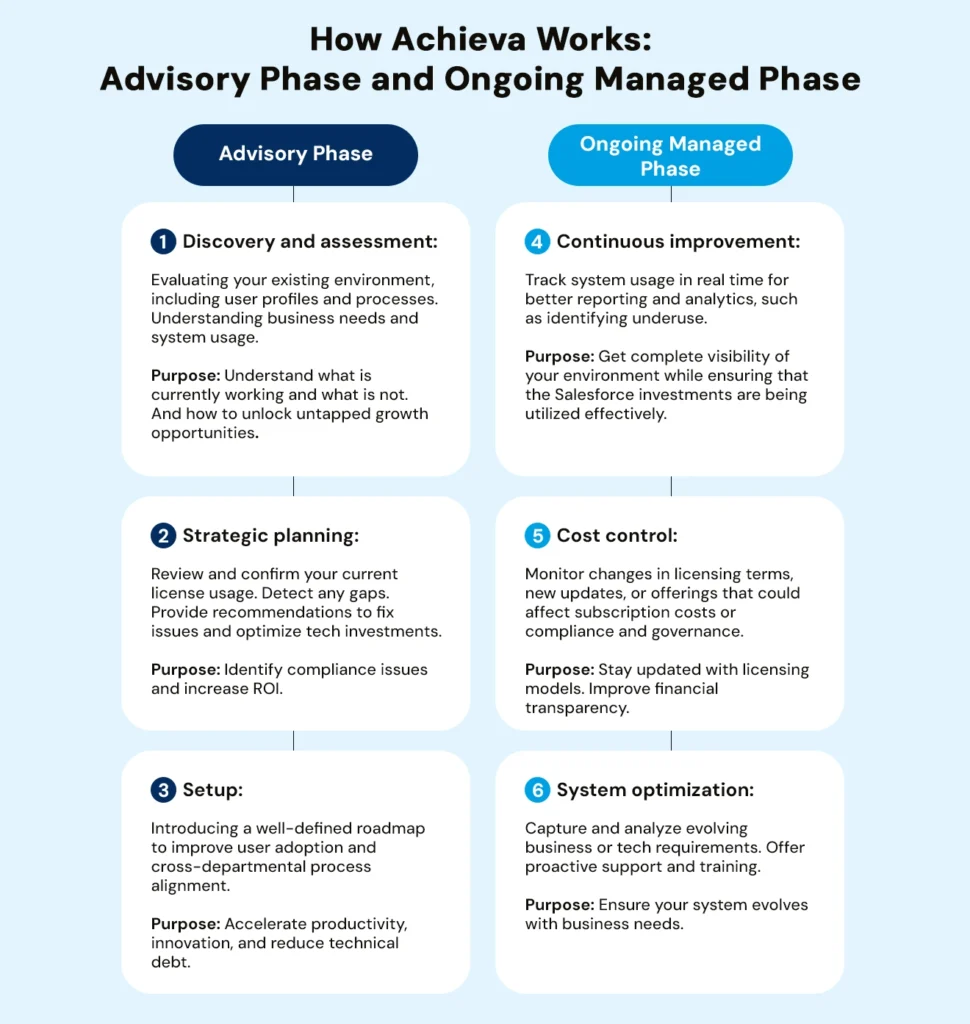
We split this process into two stages: the advisory phase, which covers discovery assessment, strategy, and setup. And the ongoing managed phase, which focuses on continuous improvement, cost control, and system optimization.
| Advisory Phase | Ongoing Managed Phase |
|---|---|
|
1. Discovery and assessment: Evaluating your existing environment, including user profiles and processes. Understanding business needs and system usage.
|
4. Continuous improvement: Track system usage in real time for better reporting and analytics, such as identifying underuse.
|
|
2. Strategic planning:
Purpose: Identify compliance issues and increase ROI. |
5. Cost control: Monitor changes in licensing terms, new updates, or offerings that could affect subscription costs or compliance and governance. Purpose: Stay updated with licensing models. Improve financial transparency. |
|
5. Setup: Introducing a well-defined roadmap to improve user adoption and cross-departmental process alignment. Purpose: Accelerate productivity, innovation, and reduce technical debt. |
6. System optimization: Capture and analyze evolving business or tech requirements. Offer proactive support and training. Purpose: Ensure your system evolves with business needs. |
Conclusion
We’re living in the era of AI. Tools like ChatGPT and Google Gemini have become our assistants. AI in 2026 is expected to evolve from experimentation to enterprise-grade integration. Amid such a landscape, a mid-sized organization looking to scale, boost productivity, or increase customer satisfaction can no longer rely on legacy tools or disconnected CRM systems that don’t integrate. That’s why many have subscribed to Salesforce CRM, which today also features new-age technologies like generative AI. According to IDC, it continues to lead the CRM market with a 20.7% share. But implementing a solution is one thing, and realizing its full potential is another. Many organizations find themselves grappling with a disconnect between their Salesforce investments and the business outcomes they were set to achieve.
This is why strategic Salesforce Advisory services play a crucial role. It provides a comprehensive view of your subscriptions, analyzes license limitations and scope, and guides you on optimizing platform performance and increasing user adoption. If you’re also looking to unlock the full potential of your Salesforce CRM investments in 2026, talk to our Salesforce Cloud experts today.