 Integration Services
 Business Consulting & Advisory
 AI Solutions
 AppExchange Development
 Tailored Salesforce Engineering
 Managed Services
 Implementation

Enterprise work rarely moves in a straight line. A simple customer question can trigger several follow-ups. A sales conversation can slow down without warning. A service ticket can remain open because one small detail is missing. Behind each of these moments, teams move between systems, update records by hand, and try to keep the full picture in mind while handling everything else that demands their attention.
Over time, this way of working becomes exhausting. It relies heavily on memory, manual effort, and constant switching between tools. Small gaps appear, and those gaps quietly turn into delays, errors, or missed opportunities.

Salesforce Agentforce enters this picture with a different idea. Instead of building more tools that wait for instructions, it introduces agents that can understand intent, follow processes, and take action across workflows.
This blog explains how Salesforce Agentforce works from the inside out.
Table of Content
- What Is Salesforce Agentforce?
- How Does Salesforce Agentforce Act Across Enterprise Workflows?
- How Does Salesforce Agentforce AI Think?
- How Does Agentforce Learn Over Time?
- How Does Salesforce Agentforce Fit into Existing Enterprise Systems?
- What Is the Role of an Agentforce Service Agent?
- How Does Agentforce Earn Trust Across Enterprise Workflows?
- How Do Salesforce-Certified Agentforce Specialists Help?
- Conclusion
What Is Salesforce Agentforce?
At its core, Salesforce Agentforce is a framework for building intelligent agents inside Salesforce. These agents are not chat windows that wait for prompts. They are not rigid scripts either. They are systems designed to carry out tasks, follow rules, and move forward with a degree of independence.
Agentforce is designed to:
- Understand intent using Salesforce data and external sources
- Reason through tasks with the Atlas Reasoning Engine
- Act across different channels like service portals, mobile apps, and internal tools
- Escalate to humans when tasks require judgment, empathy, or discretion
An Agentforce agent is given a role. That role could be helping a service team resolve cases, assisting sales teams with follow-ups, or coordinating steps across systems. Once the role is defined, the agent understands what it is allowed to do, what information it can access, and when it should involve a human.
What makes this approach different is that the agent is not limited to one step at a time. It can observe a situation, decide what needs to happen next, and carry out actions across tools and workflows. It works within Salesforce, but it does not feel trapped on a single screen.
How Does Salesforce Agentforce Act Across Enterprise Workflows?
The real strength of Salesforce Agentforce lies in spanning multiple workflows rather than operating in isolation. It helps enterprises streamline workflows across sales, service, operations, and other segments. Let’s take a look:
1.Sales Workflows
Sales are very reliant on timing and repetition. If a follow-up is delayed, the interest rate might decline. If the record is not complete, it can stop the conversation. Most of the friction here comes from small chores piling up rather than from poor sales.
Agentforce agents can monitor lead activity, prompt timely responses, and update records without being asked. They ensure that nothing slips through the cracks. Rather than waiting for manual input, it makes the necessary record updates, follow-up reminders, and keeps timelines accurate. As a result, sales teams can focus on conversions rather than getting distracted by paperwork.
Eventually, this results in more consistent pipelines. Fewer leads get lost due to negligence. Sales teams spend less time recalling their next step and more time responding to prospects.
2. Service Workflows
Service teams have to be constantly ready to work under pressure. Wave after wave of requests come in. While customers want their issues resolved quickly, they also want to be heard and understood.
A Salesforce Agentforce service agent is the first line of support who doesn’t get frustrated or stressed. It can recognize a request, collect the necessary information, and address the most common issues immediately. If the problem is complicated, it hands off a well-prepared case. The human agent receives assistance rather than having to start from scratch.
This way of working limits the number of repeated actions on both sides. Customers don’t have to repeat themselves, and service teams aren’t overloaded with work.
3. Support and Operations
“Customers are more willing to ask Agentforce questions that they might hesitate to ask a human support engineer, likely out of fear of judgment or embarrassment. It feels less intimidating to most people.”
– Bernard Slowey, SVP of Digital Customer Success at Salesforce
Behind every visible interaction, operations teams manage approvals, dependencies, and system coordination. Their work is often invisible but delays here ripple outward quickly.
Agentforce supports these teams by managing handoffs and triggering workflows at the right moment. It ensures that tasks move forward when conditions are met and pause when they are not. Records stay consistent because updates happen as part of the process, not as an afterthought.
For operations teams, this reduces the constant need to check, chase, and correct. Work progresses more orderly, with fewer surprises and less rework.
Ultimate Guide to Creating AI Agents with Agentforce
How Does Salesforce Agentforce AI Think?
According to Salesforce’s second annual CIO study, AI implementation has surged 282%, highlighting how leaders are actively harnessing autonomous agents. However, how do these agents function?
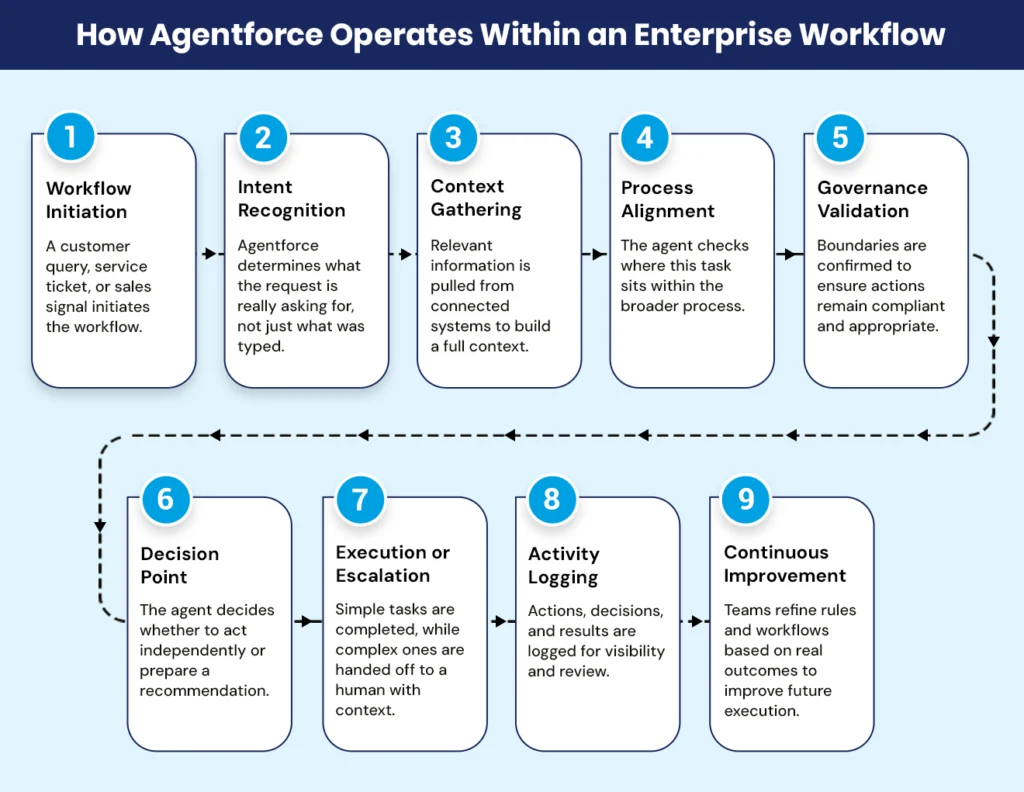
Instead of delivering scripted replies, Agentforce agents:
- Evaluate intent using context from CRM and enterprise systems
- Break requests into smaller reasoning steps
- Decide whether to act autonomously or escalate to a human
- Record decisions and results for future refinements
When something happens in the system, such as a customer request or a workflow trigger, the agent first tries to understand the goal. It looks at the context. That includes customer history, case details, business rules, and the workflow’s current state.
Instead of following a single fixed path, the agent evaluates options. For example, if a customer asks for help, the agent decides whether the issue can be resolved immediately, needs clarification, or should be escalated. This decision is not random. Predefined guardrails, policies, and organizational logic guide.
This way of thinking is structured. The agent does not guess. These are the reasons within the boundaries. If it lacks sufficient information, it asks for more information. If it reaches a limit, it pauses and hands off to a human.
That balance is important. Salesforce Agentforce AI is designed to think in a way that respects enterprise rules, not bypassing them.
Where Salesforce Agentforce Implementations Fail and How to Make It Right
How Does Agentforce Learn Over Time?
Learning in Agentforce is not about improvisation and spontaneous change. It is more about improving the execution of a task while staying within the limits set beforehand. A system is not becoming more unpredictable but rather more reliable.
When Agentforce operates across different workflows, it reviews the results. It identifies which actions resolve the issue smoothly at first touch and which are only suitable for escalation. The first pattern recognizable to the agent is that curiosity helps a person act in a certain way. Over time, these patterns help the agent handle similar situations with even greater accuracy and confidence.
Such a learning process is not so isolated. The company as a whole can review the results, rethink the rules, and rework the processes at any time. An agent can be reeducated, or its actions can be even more limited, if the behavior it displays is to be corrected. Without monitoring, nothing grows or improves.
Trust is first because learning is directed and can be seen. One can witness a slow but steady improvement at work rather than a drastic one. The system is seen as an organizational asset that can learn and improve over time, rather than a black box that changes seemingly at will and has no one to answer.
Agentforce improves over time in a controlled and thoughtful manner. The changes happen behind the scenes, so teams are not overwhelmed. In large organizations, progress that is steady and reliable is far more valuable than dramatic overnight transformation.
How Does Salesforce Agentforce Fit into Existing Enterprise Systems?
Agentforce does not ask organizations to rebuild their systems from scratch. It is designed to work within what already exists. This matters because enterprise environments are layered, interconnected, and often shaped by years of decisions.
Salesforce Agentforce respects existing data structures, permissions, and processes. Instead of forcing teams to adapt to a new way of working overnight, it adapts to how work already gets done. This makes adoption steadier and far less disruptive.
Over time, Agentforce becomes part of the organization, rather than an add-on. Teams stop thinking about where one system ends, and another begins, and work simply moves forward.
Traditional Workflow vs Agentforce-Supported Workflow
| Aspect | Traditional Enterprise Workflow | Agentforce-Driven Workflow |
|---|---|---|
|
Context handling |
Based on people’s memories or emails |
Maintained across systems automatically |
|
Task ownership |
Passed informally between teams |
Clearly assigned and tracked |
|
Follow-ups |
Manual and often delayed |
Triggered based on defined rules |
|
Visibility |
Limited to individual tools |
Shared across the workflow |
Deploy Agentforce for Intelligent Customer Interactions
What Is the Role of an Agentforce Service Agent?
“By embracing an agent-first approach, every business can redefine its operations and stay ahead – right now.”
– Adam Evans, EVP & GM, Salesforce AI Platform.
The Agentforce service agent plays a quiet but critical role in modern service operations. It is not meant to replace people. Instead, it works alongside them, taking on repetitive and preparatory work so human agents can focus on situations that need judgment, empathy, or experience.
I. Acts as the First Point of Engagement, Not the Final Authority
A service agent usually steps in before a human does. It handles the early moments of a service interaction, where customers ask common questions or provide initial details. This early engagement reduces waiting time and keeps customers from feeling ignored. At the same time, the agent does not assume it should complete every interaction. It understands that its role is limited to what is clearly defined. When a situation requires interpretation or discretion, it prepares the case and passes it forward instead of forcing a conclusion.
Agentforce Assistant for Smarter, Personalized Customer Engagement in 2026
II. Handles Repeatable Service Tasks with Consistency
Many service requests follow familiar patterns. Password resets, order status checks, policy clarifications, and basic troubleshooting steps tend to repeat daily. Salesforce Agentforce service agents manage these reliably by following approved responses and known processes. This consistency reduces errors and prevents variation caused by fatigue or oversight.
Customers receive accurate information every time, while human agents are spared from the mental load of repeating the same steps across dozens of cases each day. This approach reflects what customers increasingly expect. 34% Customers say they would rather work with an AI agent than repeat themselves.
III. Gathers and Organizes Context Before Escalation
When an issue cannot be resolved automatically, the service agent does not simply escalate it. It collects relevant details, reviews previous interactions, and attaches context to the case. This preparation ensures that the human agent who takes over has a clear understanding of the problem from the start. As a result, customers do not need to repeat themselves, and agents can move directly to problem-solving rather than gathering information.
IV. Knows When to Pause Instead of Pushing Forward
The defining strength of a service agent is restraint. It does not attempt to solve issues that fall outside its scope. When it detects ambiguity, conflicting information, or sensitive situations, it stops and escalates appropriately. This prevents errors that can occur when systems overreach. By pausing at the right moment, the agent supports trust and protects the quality of the service experience.
How Does Agentforce Earn Trust Across Enterprise Workflows?
At the core of every enterprise system is trust. Even very helpful tools can create suspicion if there is no clear oversight. Here’s how Agentforce helps build trust:
1. Establishes Clear Boundaries
Agentforce is structured and accountable, so organizations can still control how work gets done. Each agent is given specified permissions by the organization with which it works. These permissions specify the kind of information the agent is allowed to access, and the kind of actions it is allowed to perform. In doing so, businesses not only avoid misuse but also ensure the agent is in line with their internal policies. Deploying Agentforce becomes much easier with this kind of clarity.
2. Maintains Transparency
Trust depends greatly on transparency. Agentforce keeps a log of the actions and decisions, so it is always possible to go back and see what happened and why. This opens the organization to further scrutiny of its activities, correction of its mistakes, and gradual improvement of its processes. When the teams know the agent’s mode of operation, they will naturally be more confident.
3. Holds Humans Accountable
Agentforce aids decision-making but does not absolve humans of accountability. It is the humans who remain responsible for monitoring and making the final call. This common responsibility guarantees that the system will elevate rather than diminish human work. Besides, it fosters a thoughtful use rather than blind dependence.
4. Ensures Predictability
Trust is earned through consistency. Agentforce behaves predictably because it follows defined rules and workflows. Over time, teams learn what to expect from the system, reduce hesitation, and increase adoption. Predictability becomes a strength, not a limitation.
How to Separate Real Salesforce Expertise from Surface-Level Promises
How Do Salesforce-Certified Agentforce Specialists Help?
Deploying Agentforce successfully requires more than a technical setup. It requires understanding how workflows, people, and responsibilities intersect. This is where a Salesforce-certified Agentforce specialist becomes essential.
Bridges Business Goals and System Behavior
A Salesforce Agentforce services provider understands how business objectives translate into agent roles and rules. They design agents that support real workflows instead of abstract use cases. This alignment prevents over-automation and ensures the system contributes meaningfully to daily operations.
Defines Clear Boundaries for Agent Behavior
Experts are perfectly aware of the areas where automation could be beneficial and where it can be a drawback. They decide on a set of guidelines that ensure agents stay on the right track by concentrating on the tasks they are meant to do. These boundaries not only safeguard the quality of service but also avoid the occurrence of conflicts between the systems and the teams.
Minimizes Risk During Rollout
Sometimes, agents are not configured properly, which may lead to confusion. A certified specialist can anticipate risks and incorporate protective measures from the outset. Hence, problems arising from repeated mistakes during the rollout are minimized, and stakeholders’ confidence is strengthened.
Signals Accountability and Readiness
A certification is a sign that the individual heading for the implementation is fully aware of both the technology and its consequences. Such a trust, boosting factor is especially significant in enterprise environments where trust and accountability are absolute musts.
Conclusion
Salesforce Agentforce is a change in how workflows within enterprises. It brings in agents who think thoughtfully, take responsible actions, and engage in limited learning. That said, it is not a miracle maker. But it does provide continuity, less friction, and better flow.
Agentforce makes sales, service, and operations feel more coherent and even more human. And in an increasingly complex world, such calm competence is no longer a luxury. It is a necessity.