 Integration Services
 Business Consulting & Advisory
 AI Solutions
 AppExchange Development
 Tailored Salesforce Engineering
 Managed Services
 Implementation

The landscape of customer relationship management (CRM) has undergone significant shifts over the past few years. In the early days, businesses relied on traditional CRM systems. These were basically on-premise systems used to track sales activities and store contacts. The information was stored locally on the organization’s own servers and legacy systems and was managed by the IT staff. These systems offered limited operational flexibility and provided a fragmented view into customer history. However, COVID-19 disrupted this method, as remote work, digital-first engagement, and increased online interactions exposed the limitations of traditional CRMs. Enter cloud-based, modern CRMs into the picture.
They are accessible from anywhere. And provide structured, transactional data for sales, service, and marketing. That said, customers’ needs are growing at a much faster pace. People can order a cab, get pizza delivered within a few minutes, and receive same-day Amazon delivery with just a few simple taps. Binge-watch a new TV show anytime, anywhere. Get concise information about a topic through a short 30-60 second YouTube short. And with AI in the mix, obtain information on almost everything within a few seconds. That’s why customers want businesses to be available 24/7. They expect brands to know their preferences, context, history, and intent. Just all of it. For example, a customer might inquire about a late delivery on the app and may call the customer support team the very same day, pressing for more information. Without unified, real-time insights across all touchpoints, whether web, mobile, social media, or offline channels, the agent will not be aware. And just this one negative experience (having to explain the issue the customer is facing from scratch) can impact the relationship.
This is where an AI-driven, modern unified customer view offered by Salesforce Data 360 can help. It offers a holistic 360-degree view of the customer’s journey. For instance, the date of their first purchase, interaction transcripts, and CSAT scores, among others. Data 360 focuses on “what and why” of customer behavior. It works with modern CRMs such as Salesforce to provide real-time insights that can help agents make strategic decisions and deliver more personalized services.

What Is Salesforce Data 360?
Data 360 (formerly Data Cloud) is a data platform that unifies all the company’s data onto the Salesforce platform. It includes both structured (such as spreadsheets and documents) and unstructured data (images, audio, and video), providing every team with a unified, holistic view of the customer to personalize engagement. It’s easy to access and understand. It also includes diverse data sets, such as telemetric data, IoT data, web engagement data across internal systems, data lakes, and data warehouses. The next wave of Data 360 offers improved scalability and performance, AI readiness, and hyper-personalization.
It’s interactive and easier to access. And thanks to this unified, real-time, and insightful view, your marketing, sales, and service teams can build more personalized customer experiences.
Let’s consider an example of a customer who initially interacted with chat support regarding a late ecommerce delivery and later connected on a call to obtain more information sooner. However, the agent now has visibility into the last chat transcript and the resolution offered. They can also view the challenge. Consequently, upon calling, the agent can offer a more empathetic and engaging solution. This is also helpful for the marketing and sales teams, who can track the journey of users who’ve interacted with the business, target them more accurately, and boost overall engagement.
That may be why the Salesforce Data 360 momentum is soaring. According to recent news, Data 360 saw 130% year-over-year growth in paid customers and processed more than two quadrillion records per quarter.
Furthermore, Data 360 also serves as the foundation for Agentforce Agents, Einstein AI, GPT integrations, and advanced analytics.
Core Capabilities Driving AI-Powered Customer 360
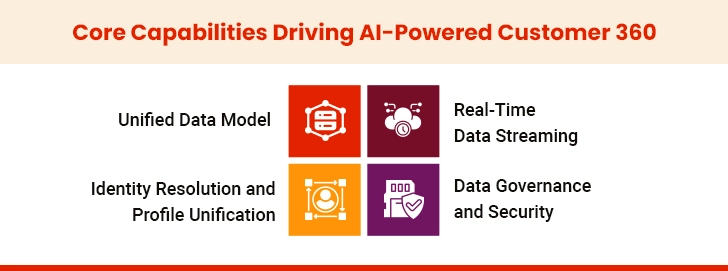
Unified Data Model
Businesses today generate a massive amount of data. And it can come from multiple touchpoints. IoT. Social. Support. It’s of no use, as a business may struggle to derive meaningful insights unless this data is unified and easily visible. This is what Data 360 does. It harmonizes all these different sources into consistent schemas and relationships.
Real-Time Data Streaming
Data batch processing is now an ancient methodology. Streaming ingestion holds the key to success and meeting customer expectations, which are continually rising with each digital update or revolution. This way, an AI model can immediately react. For example, recommending a deal or a promotional offer quickly after a customer browses a product. This improves the chances of conversion.
Identity Resolution and Profile Unification
It’s the single source of truth because it unifies data from multiple, disparate sources. But how does Data 360 do that?
Through AI-driven identity resolution, record linkage, and entity matching. This unifies the profile, eliminating duplication and fragmentation.
Data Governance and Security
Data 360 embeds governance features: classification and tagging, policy-based access control, encryption key management, and compliance with HIPAA, GDPR, and other industry regulations. These controls serve as guardrails to prevent misuse or retention of sensitive customer data, including behavioral patterns, addresses, and contact information.
Why is Data 360 Critical for AI-First Businesses?
AI Without Quality Data = Hallucination Risks
Whether it’s an AI model, such as a chatbot or a recommendation engine, it requires accurate, contextual, and up-to-date data to provide accurate responses. Biased, misaligned data and a lack of explainability are some of the reasons why some AI models fail.
But with Data 360, that’s never the case. It cleanses, harmonizes, and prepares data for AI.
Base for Predictive Analytics, Next-Best Actions, and Journeys
Single, unified, real-time Data 360 unified customer view is a boon for businesses. They can use it to run predictive analytics to:
- Estimate customer lifetime value (CLV)
- Forecast product purchases during an upcoming festival
- Predict during which period customers are likely to churn
These insights can be utilized to build more personalized CX journeys. Offering more tailored services. Customized communication.
Fueling Agentforce Agents
Salesforce’s Agentforce-powered AI agents need a reliable data substrate to pull from. Data 360 acts as that substrate. Since they’re all part of one ecosystem. There are no messy integrations.
Industry Use Cases
As we have already understood the benefits of Data 360 adoption. Let’s now see the impact in some of the industries:
| Industry | Use Cases |
|---|---|
|
Match technician to the job automatically |
Patient 360 & care coordinationPatient 360 & care coordination
Data 360 can unify critical data, including electronic health records (EHR), appointment history, wearable sensor data, and patient feedback. Healthcare providers can view this data from a single, unified view and take proactive steps, such as providing personalized care recommendations and offering suggestions based on health records. This one critical step can help save more lives. |
|
Insurance |
AI-driven claims and risk profilingWith Data 360, insurers can achieve unified visibility into customers’ profiles. Besides demographic details, insurers can also access claims history, telemetry (for cars) / IoT data (for homes), as well as social signals. AI models can flag suspicious claims, automate routine cases, and direct urgent requests to the appropriate agent, thereby reducing resolution times. |
|
Retail |
Personalized product recommendations and dynamic pricing For example, during online peak sales windows at retail stores or marketplaces like Nike and Adidas, a dynamic pricing engine can adapt to each consumer’s context. This can facilitate more sales as users receive recommendations based on their location, discounts, and behavior. |
Future Outlook: AI+ Data 360 + Automation
The convergence of Data 360, AI agents, and automation will define the next generation of Customer 360.
Proactive Experience
Not reactive, but proactive. Instead of waiting for customers to initiate interactions, AI will automatically trigger them based on behavior and trends.
Autonomous Decision-Making
AI will automate mundane tasks. Execute generic issues. Escalate sensitive and urgent cases to the right team. And coordinate journeys end-to-end.
Continuous Learning Feedback
In general, learning never stops. That mantra also persists with AI models. Data from AI actions will be updated in real time, improving the overall customer journey and offers.
Final Thoughts
Companies are collecting more data about their customers than ever before. Approximately 402.74 million terabytes of data are created each day. But if this data is still sitting in siloes and is disconnected from the customer experience, you’re leaving money on the table. This is what Data 360 aims to solve. It unifies and integrates information from various sources. It transforms raw signals into action. It brings together your data, your people, and your customers.
If you’re looking to make a transition to a platform that helps you build memorable CX, then Damco can be your implementation partner. Connect with our dedicated pool of Data 360 experts to get started.