 Integration Services
 Business Consulting & Advisory
 AI Solutions
 AppExchange Development
 Tailored Salesforce Engineering
 Managed Services
 Implementation

What if every single customer interaction, from a routine login to a complex loan application, was secretly costing your firm money? It is. Not because of the labor involved, but because of the latency.
For years, financial institutions have operated with customer data scattered across dozens of silos: the core banking system, the CRM, the marketing cloud, and the fraud detection engine. As the CTO, you know this fragmentation isn’t just a compliance headache; it’s a massive drag on business. Every time an advisor waits 30 seconds for a historical view, every time an underwriter manually cross-references two systems, you’re losing speed, losing accuracy, and losing the opportunity to sell.
Now imagine if all that data, including every transaction, every customer interaction, every account detail, lived in one unified, real-time platform. That’s exactly what Salesforce Data 360, formerly known as Data Cloud, offers.
With Data 360, financial institutions can connect fragmented data sources, create a single source of truth, and use real-time intelligence to make smarter decisions. Whether it’s personalizing client experiences, improving compliance, or accelerating loan approvals, the platform helps banks, insurers, and investment firms turn scattered data into actionable insights.

In this blog, we’ll explore how financial services firms are harnessing Data 360 to reshape customer engagement, boost efficiency, and prepare for a data-driven future. You’ll also see how Salesforce Data 360 consulting and implementation services make adoption easier and more effective.
Table of Content
- What Is Salesforce Data 360 and Why Does It Matter for Financial Services?
- Key Use Cases of Salesforce Data 360
- How Are Banks and Fintechs Using Salesforce Data 360 to Personalize Customer Journeys?
- How Does Salesforce Data 360 Improve Decision-Making in Financial Firms?
- How Does Salesforce Data 360 Enhance Marketing Efficiency in Financial Services?
- What Role Does Salesforce Data 360 Play in Compliance and Risk Management?
- How Are Investment Firms Using Salesforce Data 360 to Strengthen Client Relationships?
- How Does Salesforce Database Cloud Enable Secure, Scalable Growth?
- What Should Firms Expect from Salesforce Data 360 Services?
- How Can Financial Institutions Gear Up to a Data-Driven Future with Salesforce?
- Conclusion
What Is Salesforce Data 360 and Why Does It Matter for Financial Services?
“Data Cloud is the leading data activation layer on the market because of its ability to unify data and metadata from any location and harmonize it to power every agent action, automation, and insight.” – Rahul Auradkar, EVP & GM, Unified Data Services & Einstein, Salesforce.
According to Salesforce’s latest report, Data 360 has experienced a 130% year-over-year growth in paid customers and now processes over two quadrillion records per quarter. These results show why Data 360 solutions are fast becoming a necessity rather than an option. Let’s uncover why it matters for financial services:
- Unified Solution: Financial services firms are swimming in data, from customer transactions and loan histories to digital interactions and call center logs. Yet, most of this data remains trapped in silos. Data 360 helps bring all that information together into a connected platform.
- Data Consolidation: Instead of dealing with fragmented systems, banks and insurers can use Salesforce Data 360 services to unify data across departments and channels. It helps teams access customer information in a single view, improving decision-making and strengthening client relationships.
The following table shows how Salesforce Data 360 seamlessly supports both front-end customer engagement and back-end operations.
Key Use Cases of Salesforce Data 360
| Use Case | What It Entails | Business Impact |
|---|---|---|
|
Customer Personalization |
360° customer view and AI-driven insights |
Higher retention and satisfaction |
|
Loan Approvals |
Integrated credit and transaction data |
Faster processing, fewer errors |
|
Fraud Detection |
Real-time anomaly monitoring |
Reduced losses, increased trust |
|
Compliance Reporting |
Automated workflows and audit trails |
Lower risk of penalties |
How Are Banks and Fintechs Using Salesforce Data 360 to Personalize Customer Journeys?
Personalization in financial services is no longer limited to birthday greetings or basic segmentation. Salesforce Data 360 consulting helps banks use unified profiles to understand each customer’s unique journey, from their first account opening to ongoing investments.
Here’s how financial institutions are using it to enhance personalization:
Unified Customer View: By integrating data from CRM, mobile apps, and transactions, banks can create a 360-degree view of each customer.
Behavior-Based Offers: Using insights from Data 360, teams can recommend credit cards or investment products based on real purchase behavior.
AI-Driven Insights: Einstein AI within Salesforce analyzes customer patterns in real time, helping advisors provide timely suggestions.
Smarter Retention Strategies: Predictive analytics help identify clients likely to churn, enabling relationship managers to proactively engage them.
Cross-Selling Opportunities: Financial advisors can access relevant data instantly to offer services that match each client’s needs.
Consistent Experiences: Whether a client visits a branch, uses a mobile app, or speaks to support, they experience the same personalized journey.
Fun Fact: A 2025 PwC report found that 53% of consumers are more likely to remain loyal to firms that personalize their services. Salesforce Data 360 makes this possible by connecting data that was once disconnected.
How Does Salesforce Data 360 Improve Decision-Making in Financial Firms?
Decision-making in banking and insurance depends on accurate, real-time data. Outdated systems often make it difficult to trust numbers, especially when information is scattered across many tools. Salesforce Data 360 implementation services help fix this problem by improving data quality, accuracy, and speed. With a single connected platform, financial leaders can make faster, more confident decisions.
Here’s how Data 360 supports better decision-making:
1. Real-Time Dashboards
Executives no longer need to wait for manual reports. Data 360 provides them with live dashboards that show key business metrics, such as sales performance, loan approvals, and claims status, in real time. These dashboards pull data directly from different systems, ensuring the data is always current. Managers can instantly see what’s working and what needs attention. If loan processing slows down or claim numbers rise, they can react immediately. Quick insights lead to quicker actions, which makes operations smoother and customers happier.
2. Data Quality Control
Decisions are only as good as the data behind them. In many financial firms, duplicate or incorrect records make it hard to get a clear picture. Data 360 fixes this with automated data checks and cleaning tools. It merges duplicate records, corrects errors, and maintains consistent information across systems. This helps teams trust the numbers they use every day. When sales, finance, and marketing all rely on the same accurate data, their decisions align better. It also reduces confusion and time wasted verifying reports.
3. Market Trend Prediction
Understanding market changes early gives financial firms a big advantage. Salesforce Data 360 services help by connecting historical data with live updates. Built-in AI studies these patterns and predicts what might happen next. For example, a bank can see which loan products are becoming popular or which areas may face higher credit risks. Investment firms can track shifts in customer interest or market movement. These insights help leaders plan rather than react too late. It keeps them ready for both risks and opportunities.
4. Unified Platform for Aggregated Data
Loan approvals can take days when data has to move through several systems. With Salesforce Data 360 implementation, all the needed information is available in one place. The platform aggregates credit scores, income details, and identity records. Automated checks review them in seconds. This allows applications to be approved or rejected much faster. Customers get decisions sooner, and banks save time and effort. It also reduces human errors and keeps loan officers focused on higher-value tasks like risk evaluation or customer guidance.
5. Fraud Detection
Fraud is a serious problem for financial firms, but Data 360 helps detect it faster. The system constantly monitors transaction data for any anomalies. If it finds odd spending, duplicate claims, or strange login behavior, it sends alerts right away. Since it connects data from payments, CRM, and accounts, teams can see the full customer picture. This makes spotting fake activity easier and quicker. Early detection means fewer financial losses and less stress for customers. It also builds trust because clients know their data is being protected.
6. Compliance Reporting
Regulatory work takes a lot of time, and mistakes can be costly. Salesforce Data 360 consulting automates much of the compliance process. It collects and organizes data in accordance with rules such as GDPR or PCI DSS. Reports can be created with a few clicks, so teams don’t have to spend hours searching for records. Every change or update is logged, which helps during audits. Compliance officers can respond more quickly to regulators with complete, accurate data. This keeps the organization safe from penalties and improves transparency.
7. Performance Tracking
Leaders need a clear view of how teams perform. Data 360 makes this simple. It aggregates results from all departments into a single dashboard. Managers can see how branches, advisors, or agents are doing in real time. They can identify trends, spot training needs, and quickly recognize top performers. Because the data is shared and accurate, it removes bias and confusion. Over time, this helps firms plan better and reward employees fairly. Consistent tracking also motivates teams to improve and stay aligned with company goals.
How Does Salesforce Data 360 Enhance Marketing Efficiency in Financial Services?
Marketing in financial services has always been data-heavy, but most teams still struggle with incomplete data and manual campaign tracking. Salesforce Data 360 services help marketers turn scattered data into precision targeting and measurable outcomes. Let’s explore how Data 360 helps financial markets.
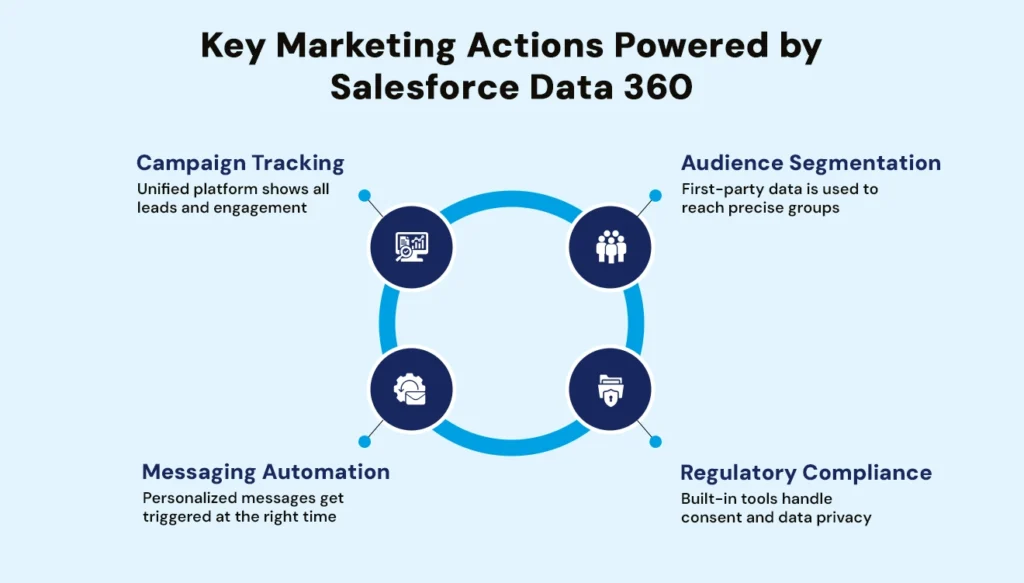
I. Unified Marketing DataEvery lead, campaign, and engagement is connected within Salesforce. This means marketing teams can see what’s working, which audiences are converting, and where to focus efforts.
II. Audience ActivationUsing first-party data, marketers can create detailed audience segments and reach them with precision across email, mobile, and social media platforms.
III. Closed-Loop AnalyticsCampaign performance data flows back into Data 360, helping teams see which actions directly impact revenue.
IV. Personalized JourneysFinancial marketers can automate personalized campaigns, such as mortgage renewal reminders or credit card upgrade offers, based on real-time triggers.
V. Compliance-Aware Marketing Marketing data stays compliant with data privacy laws since Salesforce automatically manages consent and opt-ins.
Get a 360° View of Your Customer Data
| Area | Present | Future |
|---|---|---|
|
Claims Processing |
Automated workflows |
Fully self-learning resolutions |
|
Policy Pricing |
Fixed models |
Real-time dynamic pricing |
|
Risk Assessment |
Manual scoring |
AI and IoT-driven predictive modeling |
|
Customer Service |
Scripted chatbots |
Natural, context-aware Agentforce assistants |
What Role Does Salesforce Data 360 Play in Compliance and Risk Management?
Compliance is one of the biggest challenges for financial firms. Regulations change quickly, and maintaining updated, auditable data is critical. Salesforce Data 360 consulting helps automate compliance by connecting regulatory data with operational data in real time.
Here’s how it supports compliance efforts:
- Centralized Data Access: Regulatory teams can access accurate, up-to-date client data without waiting for reports.
- Audit Trails: Every data change is recorded, simplifying audits and investigations.
- Automated Risk Alerts: Rules can be set to alert teams about suspicious activity or missing documentation.
- Data Privacy Management: Salesforce offers built-in privacy tools for GDPR and local data protection laws.
- Reduced Manual Errors: Automation cuts down the risk of human mistakes in reporting.
- Faster Remediation: Compliance teams can act immediately when risks are detected.
Did You Know? Community banks spend about 10-15% of their operating costs on regulatory compliance, diverting resources from lending and technology investments.
Companies using data automation tools see a significant decrease in compliance errors. Data 360 aligns with this trend by providing real-time, transparent visibility into sensitive data.
How Are Investment Firms Using Salesforce Data 360 to Strengthen Client Relationships?
Investment management depends heavily on trust, transparency, and timely insights. By using Salesforce Data 360 services, asset managers can better understand investor behavior and align recommendations with their financial goals.
- Investor Segmentation: Firms can categorize clients by risk appetite, investment style, and engagement history.
- Portfolio Insights: Real-time dashboards give advisors a snapshot of portfolio performance.
- Personalized Outreach: Salesforce automations trigger personalized communication after key portfolio changes.
- Client Retention: Data 360 identifies early signs of disengagement, helping firms re-engage clients quickly.
- Integrated Collaboration: Teams across advisory, research, and compliance can work from the same data source.
- Transparent Reporting: Investors can view their data through connected portals with consistent updates.
How Does Salesforce Database Cloud Enable Secure, Scalable Growth?
As financial institutions scale, their data infrastructure must handle larger volumes without performance loss. Salesforce Database Cloud provides a secure and scalable foundation that supports millions of transactions daily without downtime.
Here’s what makes it a trusted choice:
- Scalability: Data 360 can easily handle large data volumes while maintaining fast access times.
- High Availability: Salesforce’s cloud infrastructure ensures continuous uptime and data redundancy.
- Advanced Security: Data 360 offers various features such as encryption, access controls, and regular audits to protect sensitive client information.
- Integration Flexibility: The platform works smoothly with third-party systems, APIs, and legacy platforms.
- Global Compliance: It meets industry standards like ISO 27001 and SOC 2, reassuring financial clients.
- Sustainability: Salesforce’s cloud runs on renewable energy, aligning with the ESG goals of financial institutions.
Harness the Full Potential of Salesforce Data 360
What Should Firms Expect from Salesforce Data 360 Services?
A connected data ecosystem isn’t just about technology; it’s about helping teams across financial organizations work with confidence and agility.
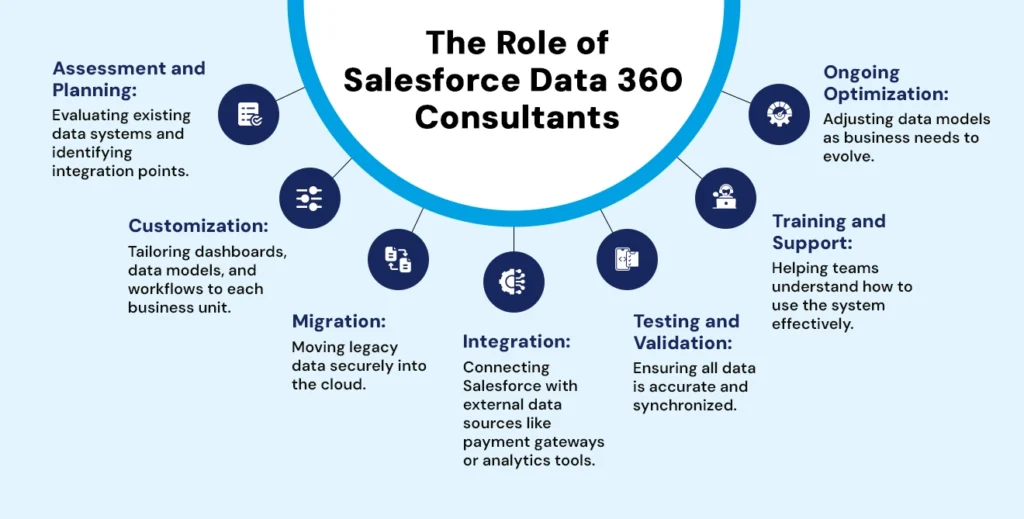
Adopting Data 360 requires proper guidance. That’s where Salesforce Data 360 consulting services play a key role. Consulting partners help financial firms plan, integrate, and optimize their data strategies. Also, implementing the platform is not just about installing new software. It is about changing how teams use data in their daily work. Salesforce Data 360 services help firms connect scattered information, improve data flow, and make smarter decisions.
Consultants guide teams through setup, customization, and training. They make sure every department, from sales to compliance, uses the platform effectively. With expert support, firms can get the most value from their data and work faster, more accurately, and with greater confidence.
How Can Financial Institutions Gear Up to a Data-Driven Future with Salesforce?
Data is the foundation of digital transformation in financial services. As financial services go more digital, data-driven strategies will drive long-term success. Data 360 unifies real-time insights, AI integration, and secure scalability. These are all essential for the decade of financial innovation to come. Financial firms that use real-time customer data to anticipate investor needs are the ones shaping the future of digital finance.
Here are actionable steps companies can follow:
1. Begin Small
It is advisable to start with a single definitive aim. Starting small helps teams to get acquainted with the platform without feeling overwhelmed. Early successes boost confidence and promote greater usage. After your initial project is successful, you can roll out Data 360 to other territories, such as loan approvals, marketing campaigns, or fraud detection. A phased approach minimizes risk and ensures rollout easier.
2. Invest in Integration
Ensure all your data streams freely between departments. Integrate CRMs, banking systems, mobile apps, and marketing software into Data 360. Integration guarantees teams view the same up-to-date information at all times. It also saves time spent on switching between systems or manually reconciling data. If systems are integrated, insights become more accurate. Employees can respond quickly to customer requests, approvals, and transactions. Integration also supports compliance, as all necessary data is centralized in a single secure location.
3. Use AI
AI can uncover insights trapped in your data. Use Salesforce Einstein and predictive analytics to discover trends and patterns. For instance, AI can detect likely-to-refinance, likely-to-invest, or likely-to-cancel customers. AI can also detect risky transactions or suspicious activity. These are insights that teams can act on before problems arise. AI eliminates time-consuming repetitive tasks, such as data scoring, risk assessment, or report creation. With real-time data, AI can make decisions more quickly, more accurately, and more strategically.
4. Measure ROI
It is prudent to measure the effect of Data 360 on your company. Track metrics like customer satisfaction, conversion rates, loan processing time, or service efficiency. Tracking outcomes enables you to visualize which processes are streamlining and which require more attention. Monitoring ROI also justifies investment in new Data 360 features or expansion initiatives.
ROI Metrics to Track
| Metric | Why It Matters | Example |
|---|---|---|
|
Customer Satisfaction |
Indicates client loyalty |
NPS score increase |
|
Loan Approval Time |
Shows operational efficiency |
Approval reduced from five days to one day |
|
Compliance Accuracy |
Reduces regulatory risk |
Fewer audit errors |
|
Marketing ROI |
Measures campaign success |
Increase in qualified leads |
5. Stay Secure
Data protection is essential in financial services. Check privacy policies and encryption procedures on a regular basis. Ensure that only authorized personnel can access sensitive customer data. Data 360 offers permission management and change tracking tools for every action in your system. Always bear in mind that security audits must be regular, not ad hoc.
6. Collaborate with Experts
Collaborate with a Salesforce Data 360 consulting firm to maximize the power of the platform. Consultants lead strategy, integration, and training. They help uncover opportunities and bypass typical mistakes. Expert partners give continued support. Their expertise guarantees that your team uses the platform effectively.
Conclusion
In the world of finance, data powers every decision. Through Salesforce Data 360, institutions are able to transition from disparate systems to a single, unified intelligence. With the right Salesforce Data 360 consulting and implementation services, companies can create deeper customer relationships, accelerate compliance, and inform growth.
By making an investment in Salesforce Database Cloud, they also acquire the security, scalability, and performance necessary for long-term success. As the financial world continues to change, those who consolidate and engage their data now will be the ones building the future tomorrow.